
Note: Links to related news coverage can be found at the story’s end.
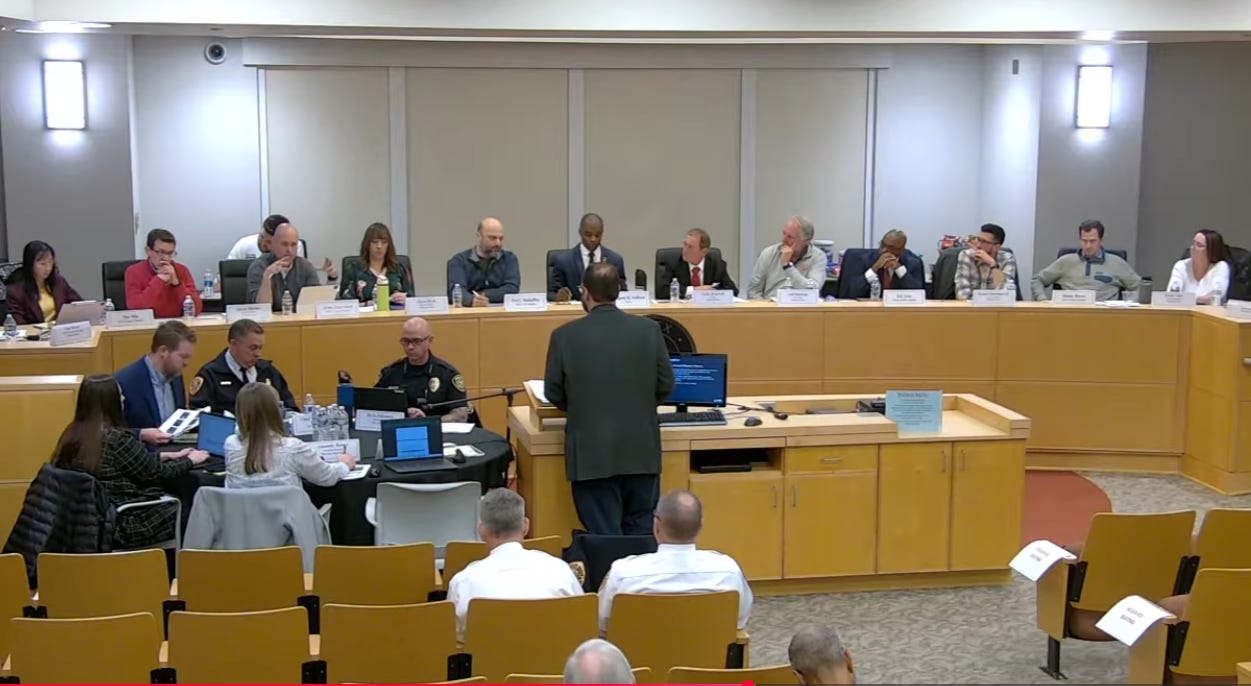
Apex, NC, Jan. 23, 2026 — Apex leaders spent more than three hours this past Thursday examining what it would mean for the town to host a large-scale data center, as council members and planning board officials weighed the long-term impacts such facilities could have on power, water, and infrastructure capacity.
The January 22nd joint work session (Agenda Packet), held at Apex Town Hall, was not tied to a specific development proposal and included no votes. Instead, it served as a detailed, technical briefing designed to help elected officials better understand the scale, risks, and long-term commitments associated with modern data centers, particularly as interest in the region continues to grow.
What emerged over the course of the evening was a clear theme: while data centers can bring investment and tax revenue, they also impose significant infrastructure demands and long-term obligations that are difficult to reverse.
A conversation about scale, not speculation
Town staff opened the session by explaining what today’s data centers actually are, and what they are not.
While smaller enterprise facilities exist, the discussion focused primarily on hyperscale data centers, the massive operations used by major technology companies to support cloud computing and artificial intelligence. These facilities operate around the clock, rely on constant cooling, and require multiple layers of backup systems to avoid even brief outages.
Unlike warehouses or office buildings, staff noted, data centers are defined not by the number of people inside them, but by the strain they place on utilities. A single hyperscale facility can require tens, or even hundreds, of megawatts of electricity, along with enormous volumes of water for cooling.
Power demand quickly became the central issue
Energy use emerged early as one of the most significant concerns discussed during the meeting.
Staff cited national data showing that data centers already account for roughly four percent of U.S. electricity use, a figure projected to rise to as much as 12 percent by 2028, largely driven by artificial intelligence workloads.
Duke Energy representatives explained that North Carolina is already experiencing rapid growth in electricity demand from population growth, electrification, and industrial expansion. At the same time, new generation capacity can take years, sometimes decades, to come online.
Large-scale nuclear or small modular reactor projects, often cited as long-term solutions, are not expected to be operational until the mid-to-late 2030s. In the meantime, utilities may need to rely longer on existing fossil fuel plants.
Council members repeatedly asked what that meant for residents, particularly in terms of reliability and long-term costs.
Water: a finite and increasingly valuable resource
Water availability quickly emerged as another major constraint.
Staff explained that large data centers can use between one and five million gallons of water per day, primarily for cooling. By comparison, Apex’s average daily water usage sits in the same general range.
The town’s water system, which is part of a regional network, already operates near capacity during peak summer months. While Apex continues to invest in storage and treatment improvements, those projects take years to plan and construct.
Officials emphasized that water availability cannot be promised on paper; it must be physically available in the system, particularly during periods of high demand.
Wastewater capacity raised the most concern
If water supply was one challenge, wastewater capacity proved even more concerning.
Apex relies on both its own wastewater facilities and the Western Wake Regional Water Reclamation Facility. That regional system is already nearing capacity, and while expansion is planned, it is not expected to be completed until around 2042.
Staff made clear that wastewater infrastructure cannot be expanded quickly or inexpensively. Any major new user would require long-term capital investment and coordination with regional partners.
Several council members noted that approving large new demands now could lock the town into decades of infrastructure commitments.
Reclaimed water offers options — but not solutions
The use of reclaimed water for cooling was discussed as one possible way to reduce pressure on drinking water supplies.
However, staff cautioned that:
Apex does not currently have a reclaimed water distribution system
Building one would require a significant investment
Supply would still be limited
Environmental and regulatory impacts would need to be considered
While reclaimed water could play a role in the future, it was not presented as a short-term fix.
A cautious and deliberate tone from the Council
Throughout the meeting, the mayor and council members took a careful, analytical approach.
Rather than advocating for or against data centers, elected officials focused on understanding long-term impacts. Questions repeatedly returned to infrastructure capacity, utility reliability, and whether the town could realistically support this type of development without placing future burdens on residents.
The mayor frequently steered the conversation back to system-wide impacts, asking how increased demand might affect grid stability, water availability, and long-term costs. Other council members pressed staff on whether capacity truly existed today or depended on infrastructure that had yet to be funded or built.
Notably, no one pushed for fast-tracking data center development or framed it as an economic necessity.
Some topics deferred to a future meeting
Despite the session lasting more than three hours, not everything on the agenda was covered.
The mayor confirmed that discussion of public health and safety impacts, as well as comparisons to how other municipalities regulate data centers, was postponed due to time constraints. Those topics are expected to be addressed in a future work session.
Their deferral underscored a broader point: the town is still in the early stages of evaluating what data centers could mean for Apex.
The timeline reality
While “time to market” was not a central focus of the meeting, the implications were clear.
Based on infrastructure alone:
Power upgrades can take a decade or more
Water and wastewater expansions require long-term planning
Regulatory approvals add additional time
Utility interconnections often become the limiting factor
Even if a data center were approved today, it could take many years to become operational.
A larger question for Apex
By the end of the evening, the discussion had shifted beyond any single project.
The question facing Apex, as the presentation and discussion made clear, is not whether data centers can be built in North Carolina; they already are. The real question is whether the town should take on the long-term infrastructure, financial, and environmental commitments required to support them.
While data centers can bring investment and tax revenue, they also entail significant trade-offs, limited job creation, and long-lasting infrastructure obligations.
For now, Apex leaders appear intent on moving carefully.
No decisions were made. No direction was set. But the message from the dais was clear: data center consideration for Apex will be evaluated slowly, deliberately, and with long-term consequences firmly in mind.
Related
HSU Story: Proposed Apex (NC) Data Center Continues to Draw Sustained Opposition as Review Moves Forward (Jan. 18, 2026)
HSU Story: Residents, Developer Hold Noise Discussion That Escalates Into Wide-Ranging Debate on Proposed Data Center in Apex (NC) (Nov. 13, 2025)
HSU Story: Apex (NC) Residents Speak Out at Council Meeting to Oppose Proposed Data Center; Officials Outline Long Review Timeline (Nov. 3, 2025)
HSU Story: Protect Wake County (NC) Coalition Meeting Rallies Over 100 Residents to Oppose Proposed Apex Data Center (Oct. 28, 2025)
HSU Story: Proposed Data Center Near Shearon Harris Plant in Apex Spurs Debate Over Annexation, Rezoning, and Neighborhood Impacts (Aug. 27, 2025)
Thank you for such an informed recap. I’ll be following these updates closely!