
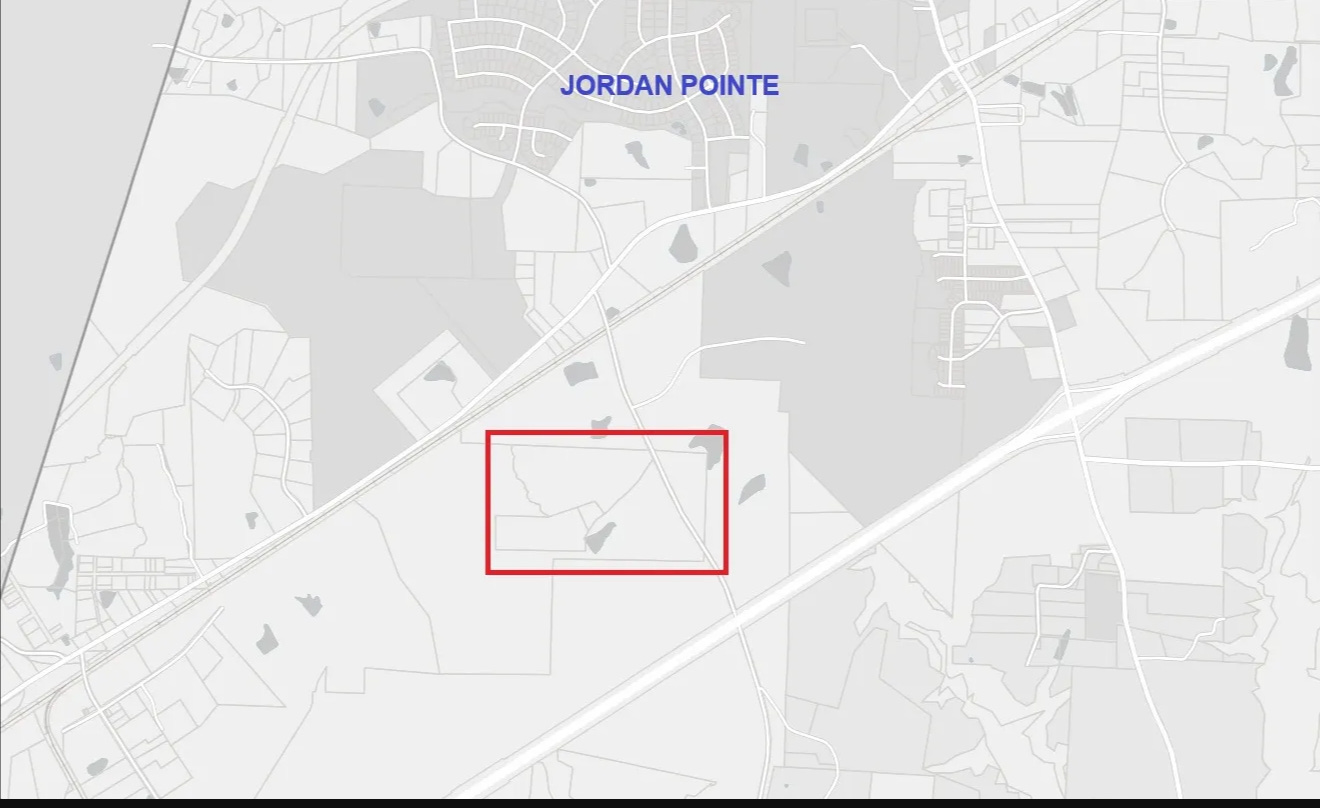
Apex, NC, Jan. 18, 2026 — A proposed large-scale data center known as the New Hill Digital Campus continues to face sustained and organized opposition as it moves through the early stages of review in Apex, with residents signaling during last Tuesday’s (Jan. 13th) Town Council meeting that pressure on town leaders is not easing.
The project, advanced by Natelli Investments, would be developed on roughly 190 acres near Old U.S. 1 and Shearon Harris Road, just south of Apex. Plans call for a multi-building data center campus constructed in phases, with several industrial-scale facilities that could ultimately total hundreds of thousands of square feet.
At full buildout, the campus could require up to 300 megawatts of electrical capacity, supplied through Duke Energy, along with extensive mechanical infrastructure, on-site backup generators, and water-based cooling systems. The cooling systems would rely primarily on treated, non-potable wastewater. As proposed, the facility would operate continuously and require significant supporting infrastructure to maintain power and temperature stability.
Because the property is currently zoned for rural residential use in Wake County, the project would require annexation into the Town of Apex, rezoning for industrial use, and multiple development approvals before construction could begin.
While supporters have pointed to potential economic benefits such as construction activity and long-term tax revenue, the scale and location of the project have generated growing concern among nearby residents. Opponents argue that the intensity of the use is incompatible with surrounding neighborhoods and raises long-term questions about infrastructure capacity, environmental impact, and public safety.
Public opposition remains concentrated and sustained
Those concerns were on full display during the Town Council meeting, where more than 26 minutes of consecutive public comment focused exclusively on the proposed data center before the forum moved on to unrelated items.
Speakers identified themselves as residents of Apex, New Hill, Fuquay-Varina, and surrounding unincorporated areas, repeatedly emphasizing that the project’s impacts would extend beyond the immediate site.
“This is not just about one neighborhood. This will affect everyone — now and in the future.”
While individual comments varied in emphasis, several themes emerged consistently throughout the evening.
Key concerns raised by residents
Public safety and emergency risk
Residents warned that large-scale lithium-ion battery systems and diesel generators introduce fire and explosion risks that could require a large-scale emergency response or evacuation.
“A thermal runaway of an uncontrolled chain reaction, unlike anything you’ve seen in the movies.”
Several speakers referenced past industrial incidents in the region as examples of how such events can quickly overwhelm local response capabilities.
Noise and quality of life
Low-frequency noise generated by cooling systems and generators was cited as a major concern. Speakers questioned whether existing noise standards adequately account for constant, low-frequency sound that can travel long distances and affect nearby homes even when decibel limits are met.
“The guidance is clear. The dBC should never be more than 15 decibels above the dBA — and yet that standard is being ignored.”
Air quality and public health
Residents raised concerns about routine generator testing and diesel exhaust emissions, noting that diesel particulate matter is a recognized health risk.
“Diesel exhaust is a known carcinogen. This isn’t hypothetical, this is routine operation.”
Speakers emphasized that these impacts would occur regularly, not only during emergencies.
Water use and environmental strain
Water demand was another recurring issue. Speakers questioned whether the region’s water resources can support a facility of this scale, particularly amid ongoing drought and population growth.
“We are already stretching our water supply, and this would push it even further.”
Concerns were also raised about downstream impacts associated with wastewater discharge.
Financial and governance concerns
Some residents warned that data center ownership structures could limit local tax benefits while exposing the town to long-term liabilities.
“These companies structure themselves so the risk stays with the community, not with them.”
Others raised concerns about transparency, the role of developers in shaping regulations, and whether existing policies are sufficient for projects of this magnitude.
Organized civic engagement taking shape
Beyond individual objections, residents made clear that opposition has become increasingly organized. Speakers referenced coordinated research efforts, the involvement of volunteer subject-matter experts, and the development of detailed policy recommendations to define how data centers should be regulated, or whether they should be permitted at all, within Apex.
“We’ve done the research. We’re prepared to share it. And we’re not going away.”
Several residents emphasized that the issue extends beyond a single project, framing the debate as a broader question of how the town plans for growth and whether current development rules adequately protect surrounding communities.
What happens next
Discussion of the proposed data center is expected to continue at a regular Town Council work session with the Planning Board on Thursday, Jan. 22, a meeting residents have repeatedly identified as a critical next step in the review process. The session is scheduled for 3:30 p.m. at Apex Town Hall, 73 Hunter Street, where council and planning officials are expected to examine data center policy, standards, and potential constraints in greater depth.
“This is the moment where you decide what kind of town this is going to be.”
As the review process continues, the volume and consistency of public comment suggest the proposal remains an unresolved and highly active issue, one that residents say they intend to continue pressing as deliberations move closer to formal decisions.