

Note: Take the reader poll at the story’s end.
Raleigh, NC, Feb. 6, 2026 — When Wake County Public School System rushed to put laptops in every student’s hands during the COVID-19 pandemic, the goal was simple and urgent: keep learning going while classrooms were closed.
Nearly six years later, that emergency response has become one of the district’s most expensive ongoing commitments, and school leaders are now openly questioning whether the original model can be sustained.
During multiple January and February 2026 board and committee meetings, Wake County school officials laid out a clear reality. The district is approaching a financial inflection point where providing a take-home laptop for every student may no longer be feasible under current funding structures.
How Wake County Got to 1:1 Devices
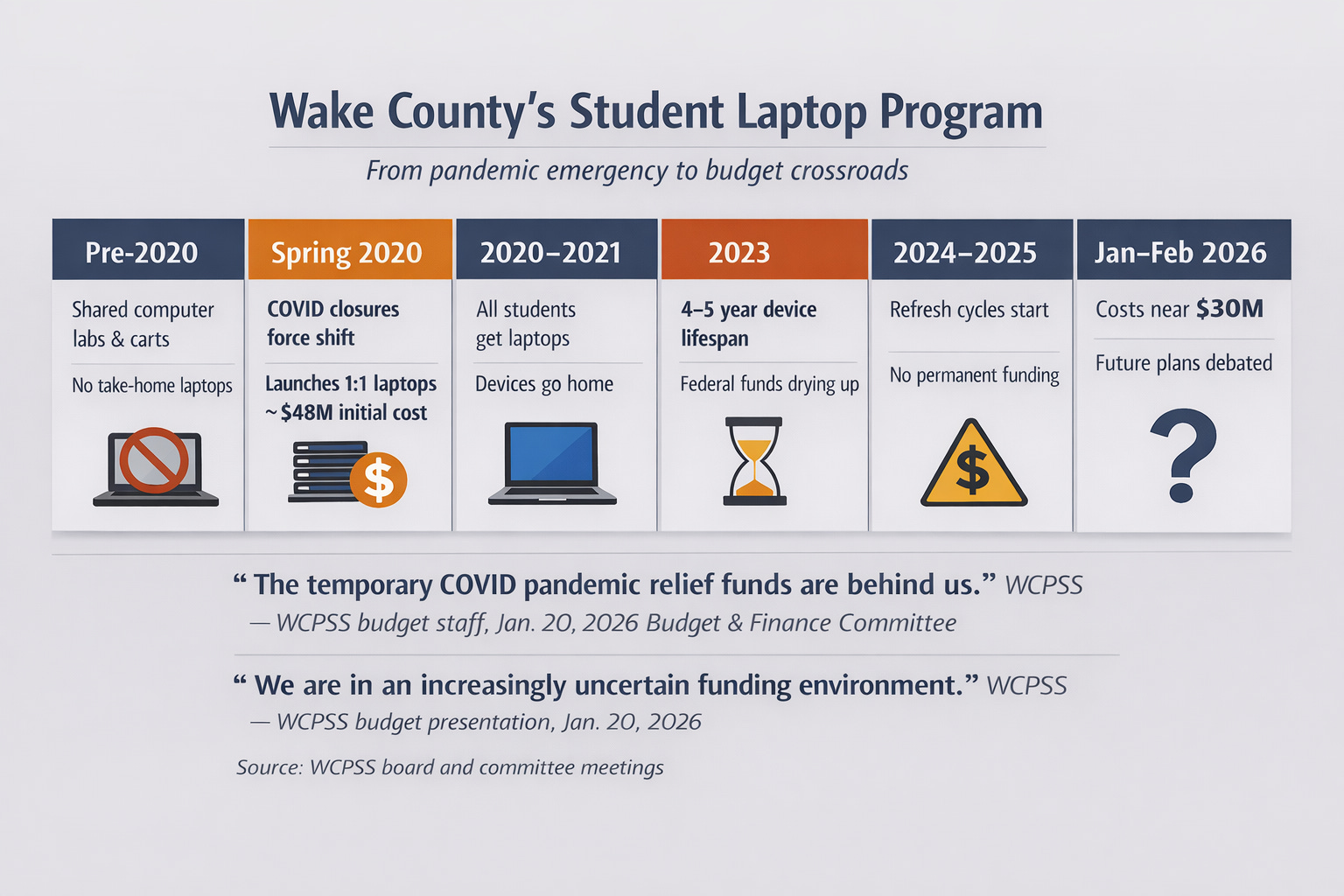
Before 2020, Wake County did not operate a universal one-to-one device program. Students typically shared devices through classroom carts or computer labs, and take-home laptops were limited to specific grades or programs.
That changed almost overnight in spring 2020.
As schools shut down, Wake County accelerated plans that had previously been discussed as multi-year goals. The district purchased and distributed tens of thousands of Chromebooks to enable remote learning. Public reporting at the time placed initial device spending at roughly $48 million, largely supported by federal pandemic relief funds.
By the 2020–21 school year, Wake County had effectively become a 1:1 district, issuing a laptop to nearly every student and allowing students to take devices home.
That emergency investment resolved one crisis but also locked the district into a new long-term obligation.
The Hidden Cost of Replacement Cycles
Laptops are not permanent infrastructure.
District officials have repeatedly emphasized that student devices have a useful lifespan of roughly four to five years, after which they must be replaced or refurbished. That replacement cycle, manageable during the years of federal COVID relief, has now collided with a far more constrained funding environment.
At recent budget and finance discussions, Wake County staff described an operating landscape shaped by:
The expiration of federal pandemic aid
Slower growth in county appropriations
Rising costs across transportation, facilities, insurance, and staffing
In that context, technology spending has become increasingly difficult to absorb. District materials and board discussions indicate that Wake County is planning for approximately $30 million per year in facilities-funded technology costs, with student device replacement representing a significant share of that total.
That figure does not represent a single “laptop line item,” but rather the broader technology budget that must now support regular device refreshes alongside software, security, and instructional tools.
February 2026: A Turning Point in the Conversation
The most explicit public discussion about scaling back the laptop program occurred during the February 3rd, 2026 committee and board meetings, when district leaders acknowledged that the pandemic-era model may no longer be realistic.
Rather than announcing an immediate end to student laptops, officials outlined several potential shifts now under consideration:
Reducing or eliminating take-home devices for younger grades
Keeping some devices on campus instead of issuing them to students
Relying more heavily on shared classroom devices
Exploring limited bring-your-own-device options, while accounting for equity concerns
No final decisions were made, but the tone of the discussion reflected a notable change. What was once framed as a universal expectation is now being reevaluated as a discretionary expense.
Instructional and Equity Tradeoffs
District leaders emphasized that the conversation is not purely financial.
Technology staff also briefed the board on classroom challenges that have emerged alongside widespread laptop use, including digital distractions, content filtering issues, and difficulties maintaining consistent instructional focus.
At the same time, board members and administrators acknowledged the equity risks of scaling back access. Not all families can afford personal devices, and the district has long advocated for universal laptops to level the playing field for students regardless of income.
That tension, between fiscal sustainability and equitable access, now sits at the center of the policy debate.
Where the Program Is Likely Headed
Based on committee discussions and budget presentations, Wake County appears to be moving toward a more targeted, less universal approach rather than an abrupt elimination of student devices.
Future models could vary by grade level, instructional need, or campus, with a greater emphasis on shared devices and in-school use. Any changes would likely be phased in over multiple years rather than implemented immediately.
For now, district leaders are gathering feedback from principals and staff while continuing to frame the laptop program within the broader reality of tightening budgets and competing priorities.
Why This Matters to Wake County Families
For families accustomed to school-issued laptops, the debate marks the end of an era shaped by pandemic necessity.
The next phase will require balancing instructional goals, student focus, equity concerns, and long-term affordability, all without the extraordinary federal funding that once made universal access possible.
Those decisions are expected to resurface in upcoming budget cycles and policy discussions later this spring.
Firsthand knowledge shows that the laptops are tossed, dropped, lost, misplaced, used for personal play, not consistently used for academic gain. Students who are motivated will find a way to persevere and accomplish their goals despite what county provides. Go to library, use those in the classroom cart while at school. The vast majority just expect to have the damaged laptop replaced with another multiple times. There was little demonstration of accountability and instrinsic motivation by either those that have and have not.