
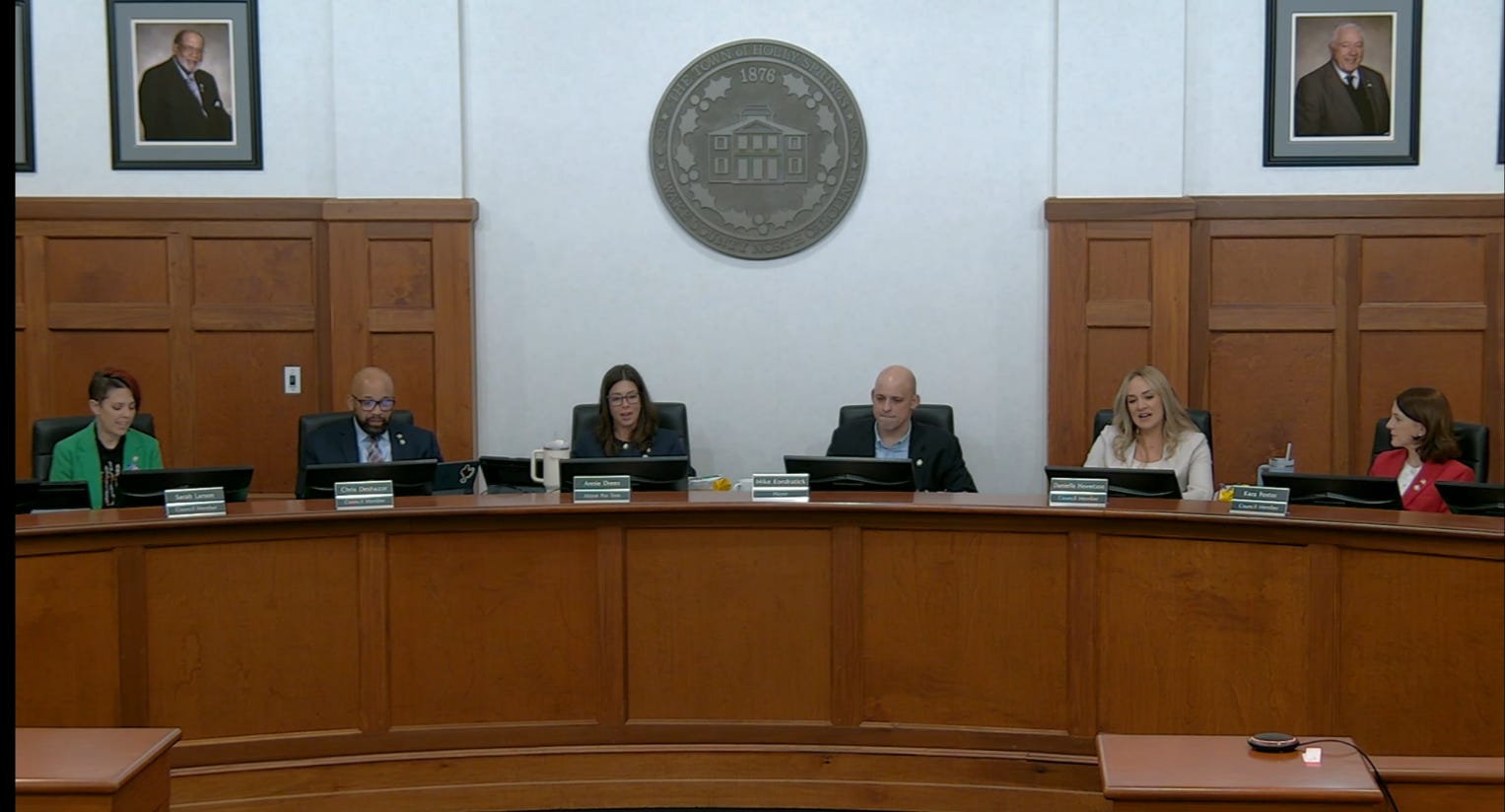
Holly Springs, Mar. 10, 2026 — During last Tuesday’s Holly Springs Town Council meeting, council members unanimously adopted the town’s 2026 Local, State, and Federal Legislative Agenda (document), outlining the issues town leaders plan to advocate for with Wake County, the North Carolina General Assembly, and federal officials in the coming year.
The agenda serves as the town’s roadmap for intergovernmental advocacy, identifying projects and policy priorities that require action or funding from higher levels of government.
Many of the town’s largest needs, particularly related to transportation, water infrastructure, and school planning, cannot be addressed by the town alone and require partnerships with county, state, or federal agencies.
Town leaders said the agenda was intentionally streamlined this year to focus on a smaller number of priorities tied directly to Holly Springs’ continued growth.
“It takes a village to run a town,” one council member said during the discussion, emphasizing the importance of collaboration across multiple levels of government.
Improving Coordination With Wake County Schools
One of the town’s key priorities involves improving coordination with the Wake County Public School System, particularly as new housing development continues across southern Wake County.
Town leaders said they want stronger data sharing and joint planning between the town and the school district, especially when new residential developments are proposed.
Currently, the town provides development information to school officials so they can estimate how many students a project may generate. The legislative agenda calls for expanding that collaboration to help ensure school construction and expansion keep pace with population growth.
The agenda also calls for additional partnerships to improve pedestrian safety near school campuses, including safer intersections, crosswalks, and traffic patterns where students walk or bike to school.
As Holly Springs continues to add new neighborhoods, town leaders said coordination among the town, school system, police, and transportation planners will become increasingly important.
Housing Affordability and Library Investment
The legislative agenda also calls for stronger collaboration with Wake County on housing affordability, an issue town leaders described as both a regional and national challenge.
While Holly Springs has experienced significant economic growth in recent years, rising housing costs have made it more difficult for some workers and families to live in the community.
Town leaders said working with Wake County could help identify strategies or programs that expand access to more attainable housing options.
Another priority involves seeking a future Wake County library bond investment in Holly Springs.
Town officials noted that the community’s current library facility is relatively small compared with the town’s population and has historically not been included in previous county library bond programs.
With Holly Springs continuing to add new residents each year, town leaders said additional library investment will likely be needed to expand services and facilities.
“Our town is growing, and we need to be able to grow with it,” a council member said during the discussion.
State Funding for Major Infrastructure Projects
Several of the town’s most significant priorities involve securing state support for major infrastructure projects tied to long-term growth.
Among the largest requests is funding support, potentially up to $200 million, to advance a regional wastewater treatment expansion partnership.
Town leaders say expanding wastewater capacity is essential to support continued residential development, biotechnology investment, and advanced manufacturing growth in southern Wake County.
The town is also seeking $25 million in state funding for a new one-million-gallon elevated water storage tank and associated infrastructure planned for the northwest area of Holly Springs.
Water storage tanks help maintain consistent water pressure, provide emergency reserves for firefighting, and provide a reliable supply during peak demand.
Transportation infrastructure is another major focus.
The legislative agenda includes advocating for a new interchange along U.S. 1, to be funded through the State Transportation Improvement Program (STIP).
Town leaders said the interchange could help reduce congestion along the busy corridor, improve access to developing areas of the community, and support continued economic development.
They also noted that several companies locating in the area have identified improved highway access as an important factor for future growth.
“We’re bringing companies here and doing a lot of good things for the state and the region,” a council member said during the discussion. “The burden shouldn’t just fall on the taxpayers of Holly Springs.”
Federal Priorities: Wastewater and Emergency Response
At the federal level, the town plans to pursue additional funding for the regional wastewater expansion project, which could also require federal investment approaching $200 million if the project advances at the regional scale envisioned by local and state officials.
The legislative agenda also includes a request for $2 million in federal funding to purchase a heavy rescue fire truck, a specialized vehicle used in complex emergencies such as serious vehicle crashes, structural collapses, or technical rescues.
Town leaders said the equipment would strengthen emergency response capabilities along U.S. 1 and Interstate 540, two major transportation corridors that carry thousands of vehicles through the region each day.
A Focused Agenda for a Changing Political Landscape
Town leaders said the legislative agenda will guide Holly Springs’ advocacy efforts with lawmakers and government agencies throughout the coming year.
Officials also noted that political changes following elections could influence how the town pursues those priorities, though the priorities themselves are expected to remain consistent.
After a brief discussion, the council unanimously adopted the legislative agenda, formally establishing the town’s advocacy priorities for 2026.