

Holly Springs, NC, Dec. 27, 2025 — As Holly Springs continues to grow, one document quietly governs nearly every subdivision, rezoning request, commercial project, and mixed-use development across town: the Unified Development Ordinance (UDO). (document)
The UDO is not a single policy decision or a one-time vote. It is the Town’s primary development law, adopted by the Town Council under state authority and applied daily by staff, boards, and elected officials. Understanding how it works is essential to understanding how growth happens in Holly Springs.
The UDO: What it is and what it is not
The UDO (document) consolidates zoning, subdivision, and development regulations into a single ordinance. It establishes rules governing:
Permitted land uses
Building height, setbacks, and density
Lot configuration and subdivision design
Open space, landscaping, and tree preservation
Parking, streets, utilities, and infrastructure
Signage and site design standards
These standards apply to all property within the Town’s corporate limits and its Extraterritorial Jurisdiction (ETJ).
In short, the UDO sets minimum requirements for development. Where provisions conflict, the more restrictive standard controls. Meeting the UDO does not guarantee project approval; it establishes the rules governing how land may be used or developed.
It is important for residents to understand that the ordinance also does not override private covenants, easements, or HOA rules, which remain enforceable separately.
Where the UDO gets its authority and how it fits into the Town’s planning Framework
The UDO is adopted pursuant to North Carolina General Statutes Chapters 160A (document) (summary) and 160D (document) (summary), which delegate zoning, subdivision, and development authority to municipalities.
The ordinance states that compliance with the UDO is a prerequisite for the use or development of real property within the Town and its ETJ. Failure to comply constitutes noncompliance and may be enforced by the Town under the ordinance’s enforcement provisions.
The UDO is the primary implementation mechanism of the Town’s Comprehensive Plan. While the Comprehensive Plan sets long-range policy goals and future land-use guidance, the UDO translates those goals into legally enforceable standards. All development plans must conform to adopted plans and policies; where a conflict arises, the UDO takes precedence.
Zoning districts: How land is classified
Every parcel of land within the Town and its ETJ is assigned a base zoning district, shown on the official zoning map.
These districts fall into three broad categories:
Residential districts, ranging from rural and suburban neighborhoods to compact residential areas
Commercial and mixed-use districts, allowing combinations of residential, retail, office, and civic uses
Employment and campus districts, accommodating business parks, innovation centers, and industrial uses

Each zoning district has specific development standards, such as allowable uses, maximum building height, minimum setbacks, density limits, and lot requirements.
Some districts, such as Special Districts and Heavy Industrial Districts, may be established only through conditional zoning, which requires additional review and approval.
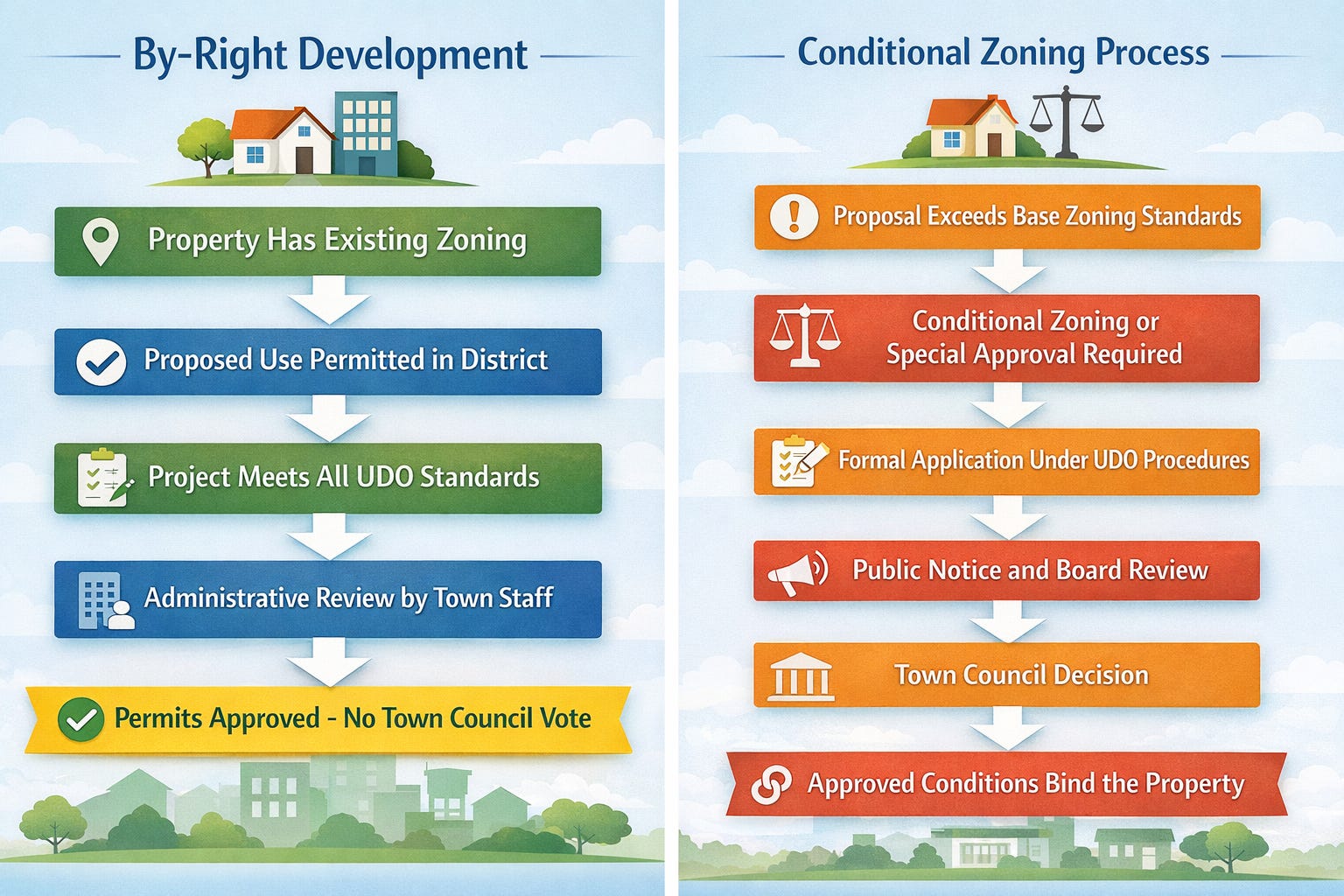
By-right development vs. conditional zoning
One of the most common misunderstandings about development in Holly Springs is the difference between by-right development and conditional zoning.
Path 1: By-right (administrative) development
If a project’s use is permitted in the zoning district and all UDO standards are met, approval occurs administratively. The Town Council does not vote on whether the project proceeds.
Path 2: Conditional zoning or discretionary approvals
Conditional zoning is a legislative process. It requires public notice, formal review, and Town Council approval, and allows site-specific conditions to be attached to the property.
Common misconceptions about the UDO, and the reality…
“Town Council decides every development.”
Reality: Many projects are approved administratively if they meet UDO standards.
“If it’s in the Town’s Comprehensive Plan, it’s automatically allowed.”
Reality: The UDO, not the plan, controls development standards.
“Zoning guarantees a specific project.”
Reality: Zoning allows categories of uses, not specific buildings.
“The UDO is flexible by default.”
Reality: The ordinance establishes minimum standards; the more restrictive rule applies.
“Older approvals last forever.”
Reality: Many prior approvals expire if development does not begin within specified timeframes.
“Conditional zoning means anything goes.”
Reality: Conditional zoning must still align with the Comprehensive Plan and the UDO framework.
“The zoning map is just a suggestion.”
Reality: The official zoning map is a legally adopted document that governs every parcel.
How the UDO relates to Wake County regulations
Another frequent point of confusion among residents is how Town rules interact with Wake County regulations.
The UDO makes this distinction clear: within Holly Springs and its ETJ, the Town’s UDO controls zoning and development, not Wake County.
Once a property is located within the Town or ETJ:
The Town assigns zoning districts
Permitted uses and development standards are governed by the UDO
Rezoning and development approvals follow Town procedures
What changes with property annexation
When land is annexed into Holly Springs or added to the ETJ, Wake County zoning no longer applies. The property is assigned a Town zoning district based on:
The Town’s Comprehensive Plan and Future Land Use Map
Existing land uses
Adjacent development and natural resources
The goal is to minimize nonconforming situations while bringing land under Town standards.
Existing Wake County approvals
Projects approved under Wake County zoning before annexation may continue under those approvals. However:
The approved plan governs what is allowed
Unused approvals may lapse
Future modifications are reviewed under the Town’s UDO
In short, annexation does not supersede prior approvals; future changes are evaluated under Town rules.
Why the UDO matters to residents
Every rezoning request, subdivision plan, and commercial project in Holly Springs is evaluated under the UDO framework. Understanding the ordinance helps residents distinguish:
What staff can approve administratively
What requires public hearings and Council action
When public input can meaningfully influence outcomes
The UDO does not determine whether Holly Springs grows; it regulates how that growth occurs.
Source Documents & Information:
Holly Springs Comprehensive Plan (click here)
Holly Springs Unified Development Ordinance (click here)
Holly Springs Land Use Maps (click here)
NC General Statute Chapter 160A (click here)
NC General Statute Chapter 160D (click here)
There are too many examples of projects that do not meet the minimum requirements of the UDO in Holly Springs. The Town Council does not get all the information, neither does the Planning Board, so their decisions are made based on the lack of information.
When people bring the issues to their attention, there does not appear to be any inquiry, because during the Town Council meetings they hear the people speak, but then move forward with blatantly obvious violations of the UDO (as if it does not exist at all) when they motion to vote on the project with no changes.
Another glaringly obvious issue is the developments are "required" to preserve trees, but one can easily see that is not being done. A current example is Norris Crossing on Avent Ferry Road. Please show me the trees designated on the development plans that can be found in the link for the project on the development map! They are no longer there...when you scroll further in the plans the town proudly displays, you can see on page 19 the plan all along was to remove those trees. How can a plan simultaneously say it is preserving trees, while also showing lots for houses with trees right in the middle? How can the "requirement" for tree preservation be satisfied when they allow the developers to remove them and destroy the natural habitats?
More people need to ask the town these questions...look at the obvious violations...if they are this obvious, how many more violations are there that require more stringent review?