
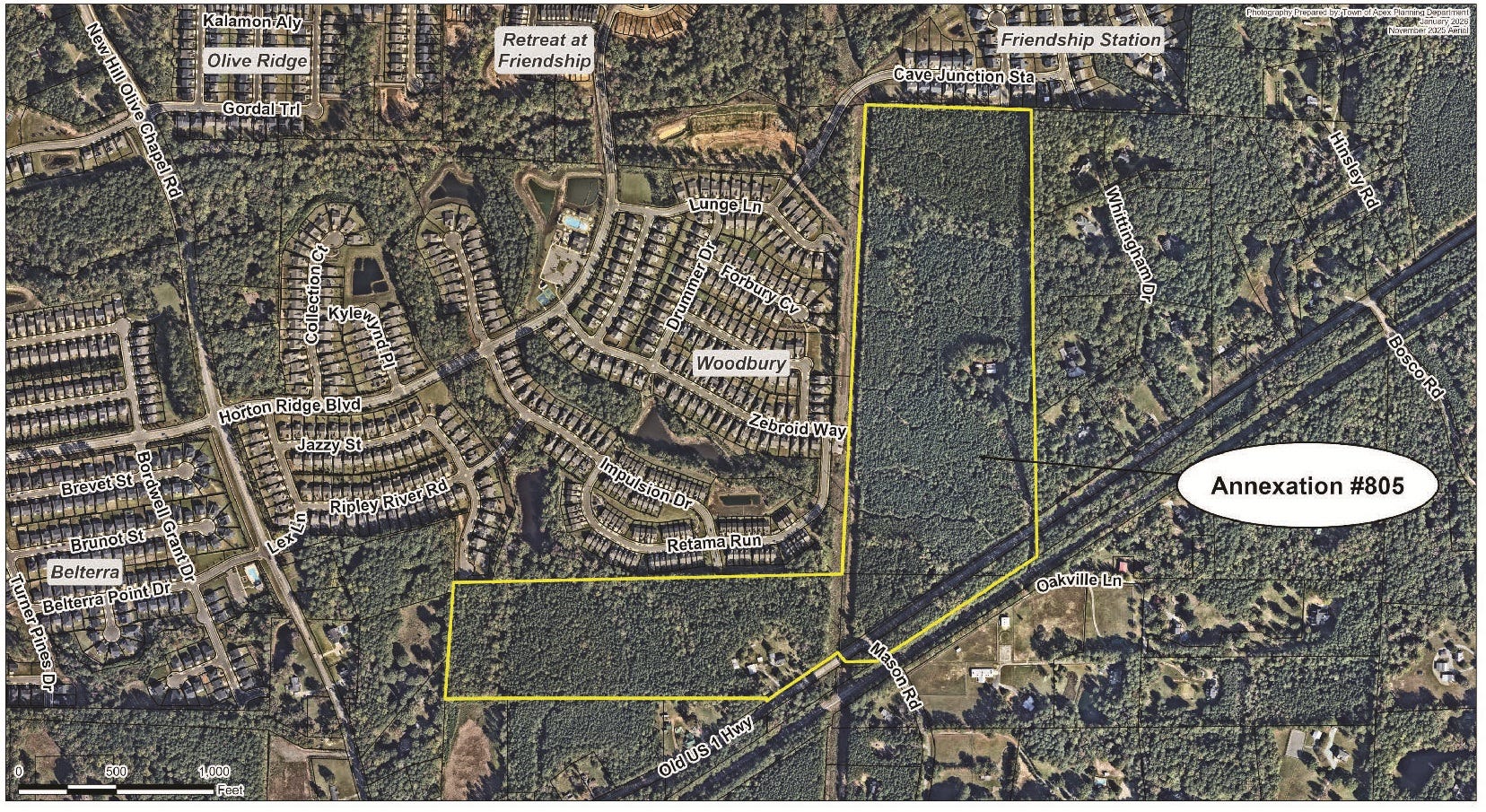
Apex, NC, Mar. 25, 2026 — An approximately 83-acre tract in Apex’s New Hill area is moving through annexation and rezoning, marking another step in the town’s westward growth into areas that have historically remained rural in character.
The site, made up of three parcels totaling roughly 83.5 acres, sits east of New Hill Olive Chapel Road and spans areas both north and south of Old U.S. Highway 1, near the railroad corridor. Today, the property remains under Wake County’s Residential-40 Watershed zoning and includes a mix of existing single-family homes, streams that bisect portions of the land, and areas that were previously wooded but have since been cleared. Annexation would bring the property into the Apex town limits, allowing access to municipal services and enabling the requested rezoning to a Planned Unit Development with conditional zoning.
From a long-range planning perspective, the proposal aligns with Apex’s adopted land use map, which designates the area for medium-density residential uses, along with potential commercial services and park space near key intersections. While that designation allows for development intensity of up to 7 units per acre, the current proposal falls significantly short of that threshold.
What the Development Would Deliver
The Welch Homestead plan calls for a mix of housing types across the site, including up to 123 single-family homes and 152 townhomes. Despite that total unit count, the overall density is approximately 3.3 units per acre, reflecting a deliberate decision to build at less than half of what the land use plan would permit.
The layout concentrates much of the development into the southeastern portion of the property, using a conservation-style approach that clusters homes on smaller lots in defined areas while leaving other portions of the site less disturbed. This approach is intended to balance development yield with open space preservation, particularly given the presence of streams and natural features across the tract.
The proposal also incorporates a range of required and voluntary elements, including roadway improvements tied to traffic impacts along Old U.S. Highway 1, internal street connections to adjacent developments, and stormwater management systems designed to meet town standards. A portion of the site is expected to be dedicated to a linear public park, providing recreational space as part of the broader development.
In addition, the plan addresses historic resources located on the property. A corn crib identified as historically significant is expected to be relocated and preserved in accordance with town requirements, while another structure, the Welch-Hearn House, has not been recommended for preservation.
Where the Proposal Meets Resistance
While the proposal fits within the framework of Apex’s long-range plan, the discussion revealed clear tension between that policy alignment and the lived reality of adjacent property owners.
Residents along the eastern boundary of the site raised concerns about how the development will interface with neighboring properties that are characterized by five- and ten-acre rural lots. The shift from low-density, large-acreage land to a denser residential community represents a substantial change in both scale and character, particularly at the property line where those uses meet.
That concern is heightened by the current condition of the land. The site, previously forested, has been logged and cleared, leaving little to no mature vegetation to serve as a natural buffer. As a result, the effectiveness of required buffering becomes a central issue, with residents questioning whether standard measures will provide adequate separation, privacy, and protection.
Proposed mitigation efforts include installing a Type A buffer and potentially constructing a retaining wall along portions of the boundary. However, those measures have introduced additional concerns, particularly related to safety. Changes in elevation, combined with structural elements, could create abrupt transitions or drop-offs near property lines, raising questions about how those features will function once built and whether they will introduce unintended hazards.
Broader Impacts: Schools and Affordability
Beyond the immediate interface between the development and adjacent properties, the proposal also brings broader infrastructure considerations into focus.
Wake County Public Schools has indicated that middle schools serving the area are already projected to face capacity constraints, with the potential for insufficient space as new students are added. As a result, future residents of the development could be subject to reassignment to other schools or changes in transportation patterns, reflecting a broader trend of growth outpacing available capacity in parts of western Apex and New Hill.
The development also includes a commitment to affordable housing, with the applicant indicating that 10 percent of the total units would be made available to households earning up to 120 percent of the area median income. While that commitment aligns with the town's policy goals, details on how those units will be implemented and integrated into the community remain under discussion.
What Comes Next
The Welch Homestead proposal has already received approval recommendations from both the Planning Department and the Planning Board, the latter of which was unanimous. Those recommendations reflect consistency with the town’s adopted land use plan and development framework.
The final decision now rests with the Town Council, which must weigh that policy alignment against the concerns raised by nearby residents and the practical implications of introducing new development into a transitioning area.
As Apex continues to expand toward New Hill, projects like Welch Homestead are becoming increasingly representative of the choices facing the town—how to accommodate planned growth while managing the immediate impacts on communities that have, until now, remained on the rural edge of that growth.