
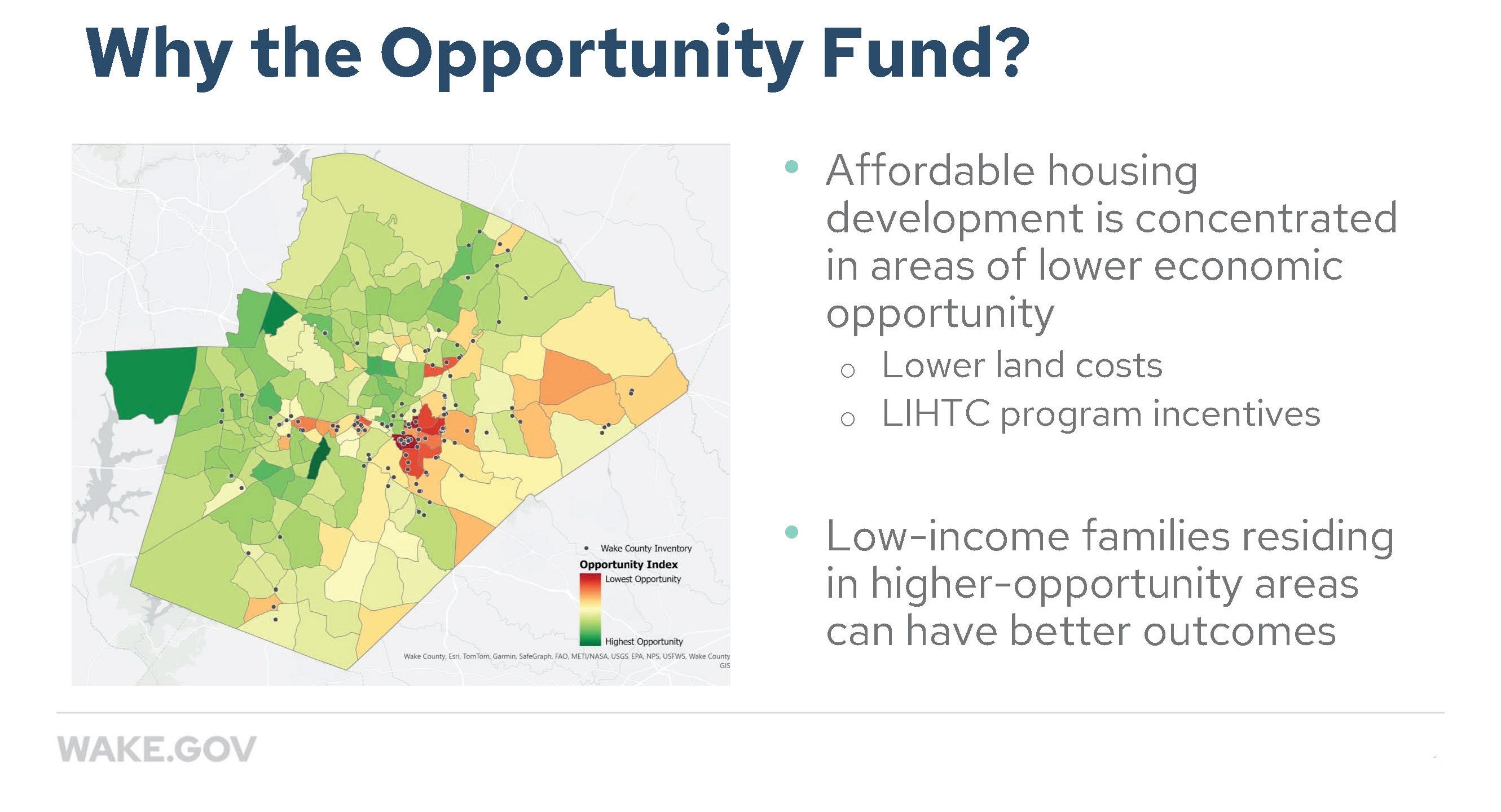
Raleigh, NC, Mar. 17, 2026 — For years, affordable housing in Wake County has followed a predictable pattern. Projects tend to cluster where land is cheaper, where incentives align, and where development is easier to finance. The result has been a steady expansion of housing in areas that are already struggling to provide access to jobs, transportation, and higher-performing schools.
Now, county leaders are preparing to test a different approach.
Through a newly announced Opportunity Impact Fund, Wake County aims to redirect where affordable housing is built, not just how much is built. The proposed $50 million fund, seeded with a $10 million county investment, is designed to help developers compete for land in areas that have historically been out of reach.
County staff were direct about the problem the fund is trying to solve. “Affordable housing development is concentrated in areas of lower economic opportunity,” they told commissioners during a March 16th presentation.
That concentration has not happened by accident. Lower land costs, fewer competing buyers, and the structure of federal tax credit programs have all nudged projects toward similar locations. Over time, that pattern has created a deeper concern, one that goes beyond housing supply.
Where a family lives can shape what comes next.
County data presented alongside the proposal (document) illustrates the gap. A child growing up in a lower-opportunity area of Wake County may earn less than $30,000 annually by age 35. In higher-opportunity areas, that same child could earn between $48,000 and $62,000.
Those numbers are driving a broader shift in thinking.
“Low-income families residing in higher-opportunity areas can have better outcomes,” staff noted, framing the fund not just as a housing initiative, but as a long-term economic strategy.
The mechanics behind the fund are intentionally designed to address one of the biggest barriers to that shift, access to land. In competitive parts of Wake County, developers often lose out on sites before traditional affordable housing financing can even come together.
The Opportunity Fund aims to close that gap.
Administered by Raleigh-based CAHEC Capital, the fund will provide two types of financing. Short-term loans will help secure land, while longer-term gap financing will help make projects viable once construction begins. The goal is speed and flexibility, giving affordable housing developers the ability to move more like market-rate competitors.
Deputy Housing Director Mark Perlman emphasized that point during the presentation. The fund, he said, is intended to allow development partners “to access funds on a timeline that will better allow them to compete for highly desirable sites.”
Just as important as how the fund works is where it will be used.
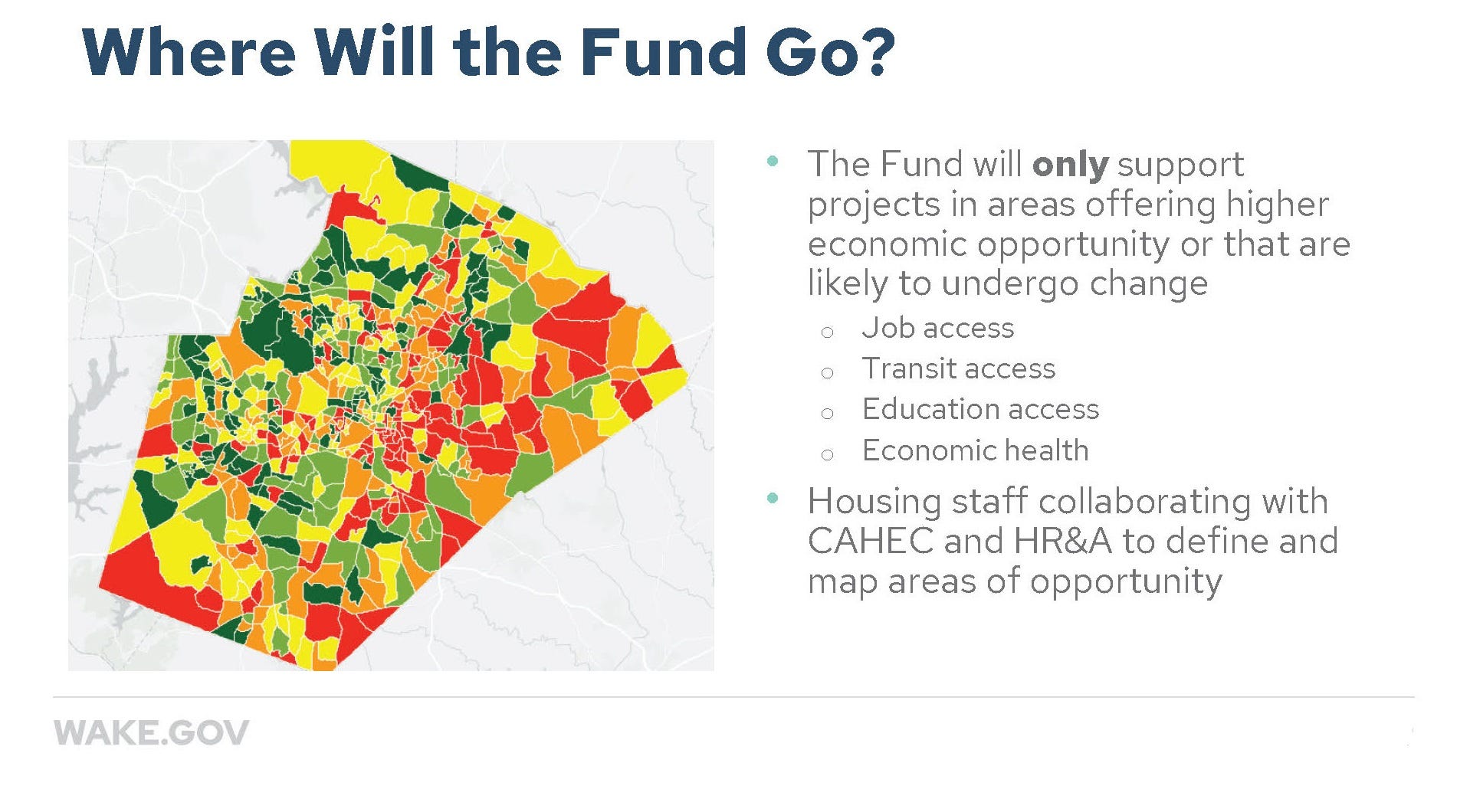
Unlike previous efforts, this program will be targeted. County officials said funding will be directed specifically toward higher-opportunity areas or places expected to become so through future transit investments or planned growth.
“We really specifically want to target those areas of higher economic opportunity,” Perlman told commissioners.
That focus could begin to reshape the geography of affordable housing in Wake County, opening the door to more mixed-income communities and broader access to economic mobility.
The timeline is aggressive. County leaders are aiming for a July 2026 launch, with fundraising already underway and early outreach to potential investors in progress. If successful, the fund would leverage the county’s initial investment five-to-one, bringing in support from banks, foundations, employers, and other partners.
Commissioners signaled early enthusiasm for the approach and offered to help connect potential investors and build momentum ahead of the launch.
“This is really exciting stuff,” one commissioner said during the meeting.
For a county still grappling with rapid growth and rising housing costs, the stakes are clear. The question is no longer just whether Wake County can build enough housing, but whether it can build it in places that expand opportunity rather than limit it.