
Holly Springs, NC, Oct. 6, 2026 — Voters in Holly Springs, Apex and Fuquay-Varina will help decide two Wake County bond referendums totaling $829.1 million and three proposed amendments to the North Carolina Constitution in the November 3rd general election.
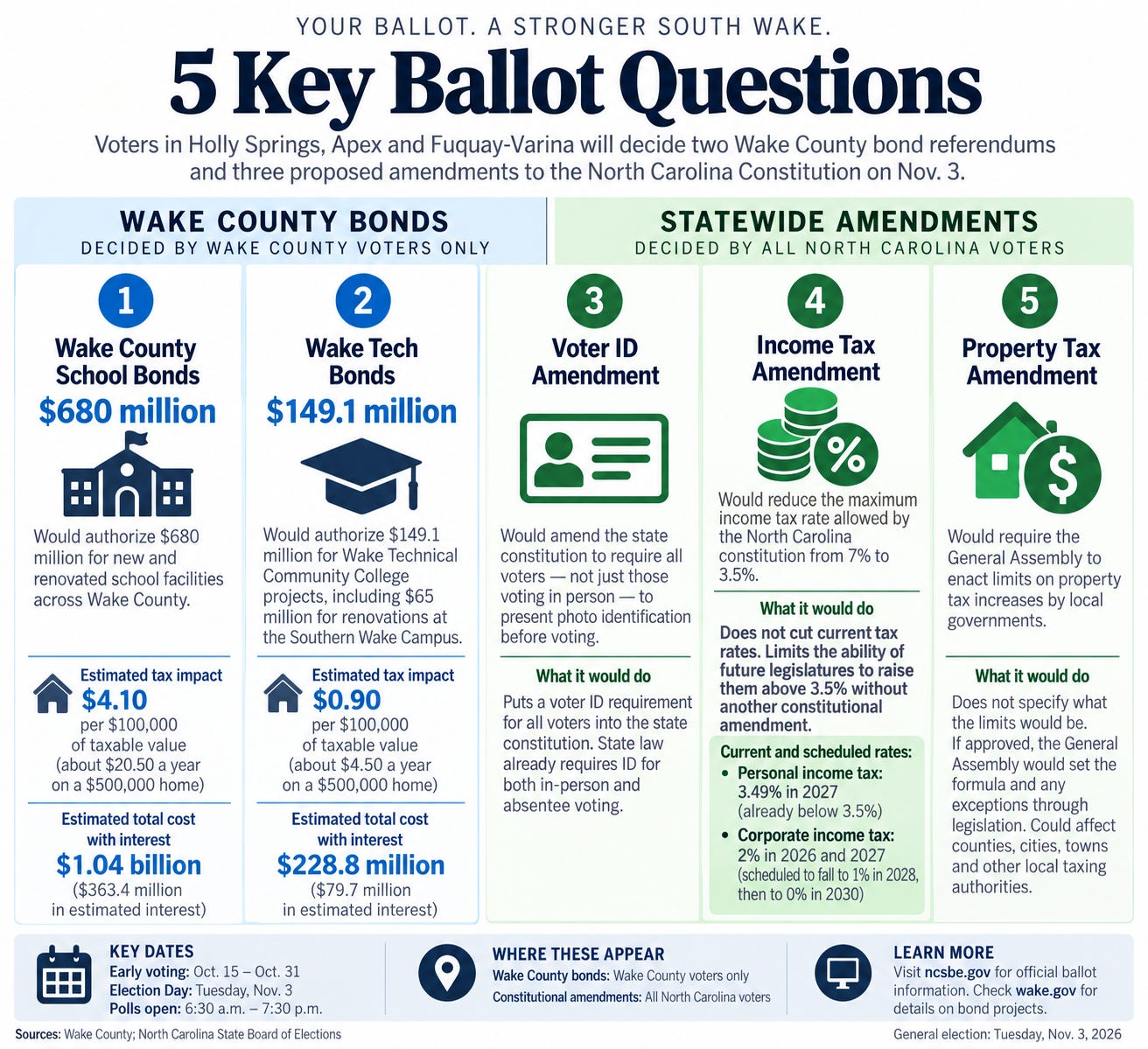
The bonds would finance projects for the Wake County Public School System and Wake Technical Community College. County estimates put the combined property tax impact at $5 annually for every $100,000 in taxable property value, or $25 on a $500,000 property.
$829 million in bonds, $443 million in estimated interest
The two referendums would authorize $829.1 million in new general obligation debt. Wake County estimates approximately $443.1 million in interest over the life of the bonds, bringing estimated principal and interest to approximately $1.27 billion.
The interest estimate uses the highest rate Wake County paid on comparable debt during the previous 20 years. Actual borrowing costs will depend on market rates, when the debt is issued, and the bonds' maturities.
The county estimates the two bonds would require a combined property tax increase of 0.50 cents per $100 of assessed value. General obligation bonds are backed by the county’s taxing authority.
$680 million for Wake County schools
The larger referendum would authorize up to $680 million to construct, renovate, expand, improve, and equip Wake County Public School System facilities.
County commissioners also have committed $152.3 million in cash funding, bringing the school capital program to approximately $832.3 million. The program, primarily covering fiscal years 2028 and 2029, includes school renovations and modernization, replacement of aging building systems, safety and accessibility improvements, reduced mobile classrooms, and additional capacity.
The county estimates the school bonds would require a property tax increase of 0.41 cents per $100 of assessed value. That equals $4.10 annually for every $100,000 in taxable property value, or approximately $20.50 on a $500,000 property.
Estimated interest is $363.4 million over the life of the bonds, bringing estimated principal and interest to approximately $1.04 billion.
$149 million for Wake Tech
The second referendum would authorize $149.1 million for Wake Technical Community College projects, including $65 million for renovations at multiple facilities on the Southern Wake Campus.
Another $41 million is planned for workforce training. That includes $20 million for public safety training, $12 million for skilled trades programs at the Southern Wake Campus, $5 million for automotive programs, $2 million for dental hygiene, and $2 million for planning future expansion in western Wake County. Remaining bond funds would support infrastructure, technology, equipment, and other renovations.
The county estimates the Wake Tech bonds would require a property tax increase of 0.09 cents per $100 of assessed value. That equals about 90 cents annually for every $100,000 in taxable property value, or $4.50 on a $500,000 property.
Estimated interest is $79.7 million, bringing estimated principal and interest to approximately $228.8 million.
How the bonds would be repaid
Voter approval would authorize the borrowing but would not establish a single interest rate or repayment schedule. Wake County can issue the debt in stages as funding is needed, with rates determined when the bonds are sold.
Wake County generally repays general obligation school debt over 15 to 20 years. County financial policies call for repaying about 70% of the principal within 10 years.
The $1.27 billion combined principal-and-interest figure is an estimate, not a fixed repayment amount. Actual costs will depend on interest rates, maturities, and when the bonds are issued.
Voter ID amendment
The first proposed constitutional amendment would expand the state constitution’s voter identification requirement.
The ballot language reads:
“Constitutional amendment to require all voters, not just those presenting to vote in person, to present photo identification before voting.”
North Carolina law already requires identification for in-person and absentee-by-mail voting. Absentee voters generally must provide a copy of acceptable identification or complete an applicable ID exception form.
The state constitution currently specifies photo identification for voters appearing in person. The amendment would extend that constitutional requirement to all voters, regardless of how they vote.
The practical change is where the requirement resides. State law now requires photo identification for absentee voters; approval would also place that requirement in the state constitution.
Income tax amendment
The second proposed amendment would reduce the maximum income tax rate allowed by the North Carolina Constitution from 7% to 3.5%. The amendment would not reduce current tax rates; its primary effect would be to limit future legislatures' ability to raise them.
The ballot language reads:
“Constitutional amendment to keep the State income tax rate from being raised higher than three and one-half percent (3.5%).”
The amendment would apply to both personal and corporate income taxes beginning with the 2027 tax year. Any future increase above 3.5% would require another constitutional amendment approved by voters.
North Carolina’s personal income tax rate is 3.99% for 2026 and is scheduled to fall to 3.49% in 2027, just below the proposed constitutional ceiling. Under current law, it is scheduled to fall again to 3.24% in 2030 and 2.99% in 2033, with possible additional reductions.
The amendment also would apply to North Carolina’s corporate income tax, which is 2% in 2026 and 2027. Under current law, that rate is scheduled to fall to 1% in 2028 and 2029 and to zero beginning in 2030.
Approval therefore would not change either tax rate currently scheduled for 2027. It would place a 3.5% constitutional ceiling on what a future General Assembly could impose for personal or corporate income taxes.
North Carolina also imposes a separate corporate franchise tax, which the scheduled phaseout of the corporate income tax would not eliminate.
Property tax amendment
The third proposed amendment would require the General Assembly to enact limits on property tax increases by local governments.
The ballot language reads:
“Constitutional amendment requiring limits on property tax increases by local governments.”
The amendment does not establish the limits. If approved, the General Assembly would determine the formula and any exceptions through subsequent legislation.
The requirement could apply to counties, cities, towns, special districts, and other local taxing authorities. The amendment does not specify whether limits would be based on inflation, population growth, property values, a fixed percentage, or another measure.
Voters will therefore decide whether the constitution should require limits on local property tax increases, while the amount and structure of those limits would be determined later by the General Assembly.
Voting begins Oct. 15th
Related Story: Wake County Voter Registration Deadline is October 9th for the Upcoming Election (10/5/2026) [Note: Story includes voter registration information]
Wake County voters will decide the two bond referendums. The three constitutional amendments will appear on ballots statewide.
In-person early voting begins Oct. 15 and ends Oct. 31. Election Day is Tuesday, Nov. 3, with polls open from 6:30 a.m. to 7:30 p.m.
Sources
Wake County Public School System Bond
Wake County Public School System — 2026 School Bond. Details the $680 million bond, $152.3 million in county cash funding and projects included in the capital program.
https://www.wcpss.net/about-us/school-facilities/design-and-construction/school-bond-2026
Wake County Board of Commissioners — Proposed General Obligation Bond Referenda for Schools and Wake Tech. Includes the bond orders, ballot questions, Statement of Disclosures, Sworn Statement of Debt and other official documents supporting both Wake County bond referendums.
https://wake.legistar.com/LegislationDetail.aspx?G=53B536B7-DAB7-4DC0-9617-B0772D508F49&GUID=FE746BCF-73F5-4A3B-8A87-6A2692401F91&ID=8065829&Options=&Search=
Wake County Board of Commissioners — Public Hearings on 2026 Bond Referenda for Schools and Wake Tech.
https://boccomment.wake.gov/AgendaItems/6235
Wake Technical Community College Bond
Wake Tech — 2026 Workforce Forward Bond. Details the $149.1 million proposal, including workforce expansion, Southern Wake Campus improvements and collegewide renewal.
https://www.waketech.edu/2026bond
Wake County Board of Commissioners — Proposed General Obligation Bond Referenda for Schools and Wake Tech.
https://wake.legistar.com/LegislationDetail.aspx?G=53B536B7-DAB7-4DC0-9617-B0772D508F49&GUID=FE746BCF-73F5-4A3B-8A87-6A2692401F91&ID=8065829&Options=&Search=
Voter ID Constitutional Amendment
North Carolina General Assembly — Senate Bill 921 / Session Law 2024-58, “Constitutional Amendment/Require Photo ID For All Voters.” The legislation places the amendment on the Nov. 3, 2026 ballot and contains the official ballot language.
https://www.ncleg.gov/BillLookUp/2023/S921/True
North Carolina General Assembly — Legislative Analysis Division summary of Senate Bill 921 / Session Law 2024-58.
https://ncleg.gov/Legislation/SummariesPublication/Summary/2024/6/S921-SMST-118%28sl%29-v-5/
Income Tax Constitutional Amendment
North Carolina General Assembly — Senate Bill 1080 / Session Law 2026-4. The enacted legislation would lower the constitutional maximum income tax rate from 7% to 3.5%.
https://www.ncleg.gov/Sessions/2025/Bills/Senate/HTML/S1080v3.html
North Carolina General Assembly — Legislative Analysis Division summary of Senate Bill 1080 / Session Law 2026-4. Confirms that the 3.5% ceiling would apply to both personal and corporate income taxes.
https://www.ncleg.gov/Legislation/SummariesPublication/Summary/2024/6/S1080-SMBA-128%28sl%29-v-10/
North Carolina Department of Revenue — Corporate Tax Law Changes. Provides the corporate income-tax schedule and related corporate tax changes.
https://www.ncdor.gov/taxes-forms/information-tax-professionals/revenue-laws/2025-tax-law-changes/2025-corporate-taxes-law-changes
Property Tax Constitutional Amendment
North Carolina General Assembly — House Bill 1089 / Session Law 2026-5. The enacted legislation requires the General Assembly to enact laws limiting increases in property-tax levies by counties, cities, towns, special districts and other units of local government if voters approve the amendment.
https://www.ncleg.gov/Sessions/2025/Bills/House/HTML/H1089v3.html
North Carolina General Assembly — Legislative Analysis Division summary of House Bill 1089 / Session Law 2026-5.
https://www.ncleg.gov/Legislation/SummariesPublication/Summary/2024/15/H1089-SMBA-129%28sl%29-v-5/
North Carolina General Assembly — PDF of House Bill 1089 / Session Law 2026-5.
https://www.ncleg.gov/Sessions/2025/Bills/House/PDF/H1089v3.pdf