
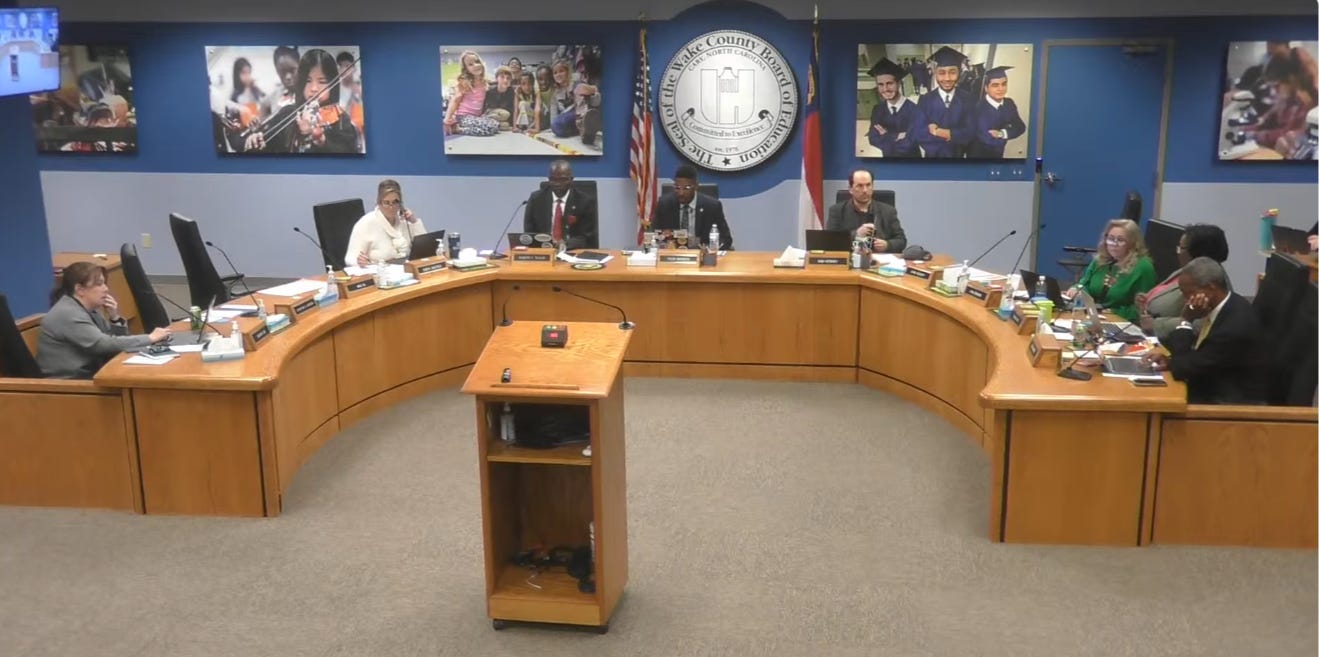
Cary, NC, Mar. 18, 2026 — Wake County school leaders on Tuesday signaled a difficult road ahead as they begin building the district’s 2026–27 operating budget, pointing to rising costs, limited flexibility, and mounting funding pressures that are expected to force tradeoffs in the months ahead.
The March 17th Board of Education meeting included an early preview (document) of the superintendent’s proposed budget, but the discussion quickly expanded beyond a technical presentation. District staff outlined the structural challenges shaping the budget, while board members and public speakers raised concerns about broader funding trends affecting public education.
Several cost drivers continue to push spending higher. District officials pointed to employee benefits, charter school payments, the opening of a new elementary school, and rising special education costs as ongoing financial pressures. Many of those expenses are fixed or formula-driven, leaving fewer areas for reductions without affecting services.
Charter school funding, in particular, was highlighted as a consistent obligation tied to county appropriations. As one explanation noted during the meeting, a portion of local funding is automatically redirected to charter schools based on enrollment formulas, creating a built-in cost that grows alongside the district’s budget.
Sponsored Advertisement

Click on the image for more information
At the same time, speakers during the meeting pointed to another source of financial strain: the rapid expansion of private school vouchers in North Carolina.
“It is also a result of investment of more than hundreds of millions of dollars per year into private school vouchers,” one speaker said during public comment, linking state-level policy decisions to local funding challenges.
Others echoed that concern more directly.
“…the voucher issue and the fact that they are draining money from the school system in ridiculous ways.”
“We can’t keep pouring money into voucher programs and meet the needs of our kids.”
North Carolina funds public schools based largely on student enrollment, meaning that shifts in where students attend school can affect how much state funding districts receive. While the Opportunity Scholarship program (website) does not directly pull from local school budgets, its expansion can influence enrollment trends, which in turn affects funding levels for public school systems like Wake County.
District leaders also acknowledged ongoing uncertainty around revenue. Officials said they expect to request roughly $25 million in additional funding from Wake County for the 2026–27 fiscal year. That figure represents an increase over current funding levels, but it is not expected to fully cover rising costs, leaving a remaining gap that will need to be addressed through adjustments elsewhere in the budget.
The district’s financial position is further complicated by reduced reserves. Fund balances that helped stabilize prior budgets have been drawn down in recent years and are now below target levels, limiting the system’s ability to absorb new expenses.
Compounding the challenge is the absence of a finalized state budget, which leaves school officials planning without clear guidance on future funding levels.
Taken together, the discussion reflected a shift in focus. Rather than considering new programs or expansions, district leaders are working to maintain current operations while preparing for difficult decisions ahead.
For board members, the preview served as an early framing of those choices. For families across southern Wake County, including Fuquay-Varina and Holly Springs, the outcome could affect staffing levels, program availability, and day-to-day school operations in the next academic year.
What’s Next
The superintendent will present the full proposed 2026–27 budget on April 7th. The board will then hold public input sessions and a formal hearing before adopting a proposed budget in May, which will be submitted to Wake County commissioners.
Simple solution: Fire everyone who isn't in front of a class full of students on a daily basis. Keep lunch staff, and bus drivers. One principal and one admin per school. If the school needs anything else, task funding and pay to the school PTA and Boosters.