
Raleigh, NC, May 7, 2026 — Wake County leaders unveiled a proposed $2.28 billion fiscal year 2027 budget during Monday night’s commissioners’ meeting that would increase property taxes by 2 cents while expanding investments in education, public safety, and social services amid what county officials described as mounting structural pressure on local government finances.
The proposed budget would raise the county’s property tax rate from 51.71 cents to 53.71 cents per $100 valuation. County Manager David Ellis said the owner of a $450,000 home would see about a $90 increase in their annual tax bill under the proposal.
But the larger message from Ellis’ presentation (document) was not simply that costs are rising. Instead, county leaders argued Wake County is increasingly being forced to absorb financial responsibilities they believe should be funded by the state, while simultaneously facing an erosion of its property tax base.
“This is the ninth budget I’ve presented to the Board since I became County Manager, and I’ll be honest, it’s been the most challenging one yet,” Ellis said during the meeting.
Wake County relies heavily on property taxes, which account for roughly 75% of county revenue. In a typical year, growth in the tax base generates between $40 million and $50 million in new revenue. For FY27, however, county officials project only about $8 million in new growth revenue.
County officials attributed much of that slowdown to two major issues: a surge in property tax appeals and rapidly growing affordable housing-related tax exemptions following a North Carolina court ruling involving Mitchell County and Blue Ridge Housing.
According to the presentation, Wake County estimates property tax appeals alone could reduce FY27 revenue by approximately $18 million. The county also projects another $12.3 million in lost revenue connected to what officials repeatedly called the “Blue Ridge loophole.”
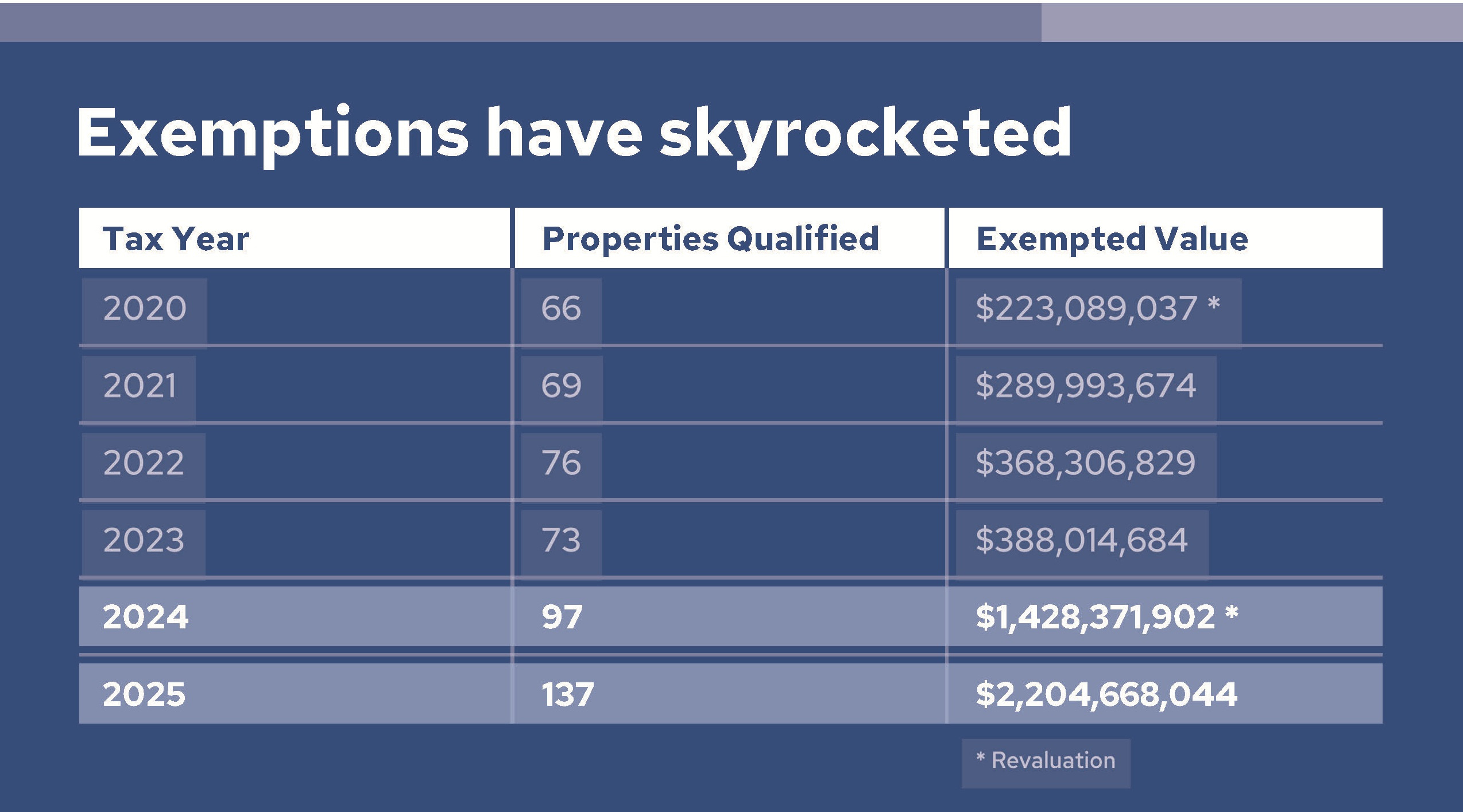
The presentation detailed how the Mitchell County v. Blue Ridge Housing case expanded apartment owners' ability to qualify for property tax exemptions through nonprofit ownership structures. County officials said the result has been a sharp increase in the value of exempted property across Wake County.
Slides presented Monday showed exempted property values rising from approximately $223 million in 2020 to more than $2.2 billion in 2025.
One example highlighted during the presentation showed an apartment complex in Raleigh shifting from fully taxable in 2024, with $104.2 million in taxable value, to 70% exempt in 2025, with only $31.3 million remaining taxable.
“The growing number of exemptions is the biggest threat to the county’s revenues that I could ever imagine,” Wake County Tax Administrator Marcus Kinrade said in the presentation materials.
Ellis repeatedly argued that counties are also increasingly subsidizing services traditionally associated with state government responsibilities.
The presentation cited county spending on:
school operations,
jail operations,
foster care housing,
Medicaid administration
and public safety staffing.
According to county figures presented Monday, Wake County estimates it filled approximately $600 million in state funding gaps during FY2026.
The county manager argued that if the state fully funded those responsibilities, Wake County’s property tax rate could be significantly lower.
“Our property tax rate could drop to 30 cents if the state did its part,” Ellis said.
The proposed FY27 budget would use $35 million from county reserves to help close the funding gap. Ellis acknowledged the move was unusual, saying he had not previously recommended using one-time funds to support recurring operations during his tenure as county manager.
Even with reserve usage and the tax increase, county officials said they denied 37 budget expansion requests totaling $10.5 million. Those rejected requests included additional inspectors, environmental consultants, customer service staff, and continued food security pilot programs.
Much of the proposed spending increase focuses on education and public safety.
The county proposes increasing Wake County Public Schools’ operating support from $742.9 million to $768.2 million. Wake Tech funding would increase from $42.6 million to $44.4 million, while Smart Start funding would rise from $8 million to $10 million.
The presentation also noted that 905 children are currently on waiting lists for Wake ThreeSchool and NC Pre-K programs.
On the public safety side, the proposal would add 16 EMT positions as emergency medical calls continue to rise. The county also plans to reopen the jail annex, adding 240 beds and 92 detention positions, at a cost of approximately $7 million in salary and benefits.
County officials said the detention system is under growing pressure because of population growth, longer inmate stays, and state prison staffing shortages that have left Wake County housing more than 100 inmates who should be in state custody.
Ellis also warned that future county budgets could become substantially more difficult if state lawmakers do not address the Blue Ridge exemption issue and pending proposals that could cap future property tax increases.
“If the state doesn’t close the Blue Ridge loophole, and if the state caps the property tax, we will have to make cuts,” Ellis said.
Those cuts, according to the presentation, could eventually include reduced operating hours, cuts to program investments, and reductions in education funding.
Commissioners did not debate the budget in detail Monday night. Instead, the board unanimously voted to formally receive the proposed budget, open a public comment period, and schedule public hearings and work sessions throughout May, with potential adoption on June 1st.
What’s Next
Wake County commissioners will continue reviewing the proposed FY27 budget throughout May.
Upcoming meetings include:
May 11th: Budget work session and public hearing
May 18th: Second public hearing
May 21st: Additional budget work session
June 1st: Board consideration of final budget adoption
Residents may also submit comments online through the county’s budget website during the review process. The portal is located here - https://www.surveymonkey.com/r/NXCLTDJ
How in the world could the tax base in Wake County be eroding with the amount of new houses and townhouses being built, especially since there are no infrastructure improvements? We had an increase last year based on new valuations what happened to all that money?? I don't get it. Maybe y'all should look at areas to cut spending. Now if the money was going to raise teacher salaries I would be okay with that. Also, where can we see where the $2.28B budget proposal is located so we can see how our money is being spent.
How in the world could the tax base in Wake County be eroding with the amount of new houses and townhouses being built, especially since there are no infrastructure improvements? We had an increase last year based on new valuations what happened to all that money?? I don't get it. Maybe y'all should look at areas to cut spending. Now if the money was going to raise teacher salaries I would be okay with that. Also, where can we see where the $2.28B budget proposal is located so we can see how our money is being spent.