
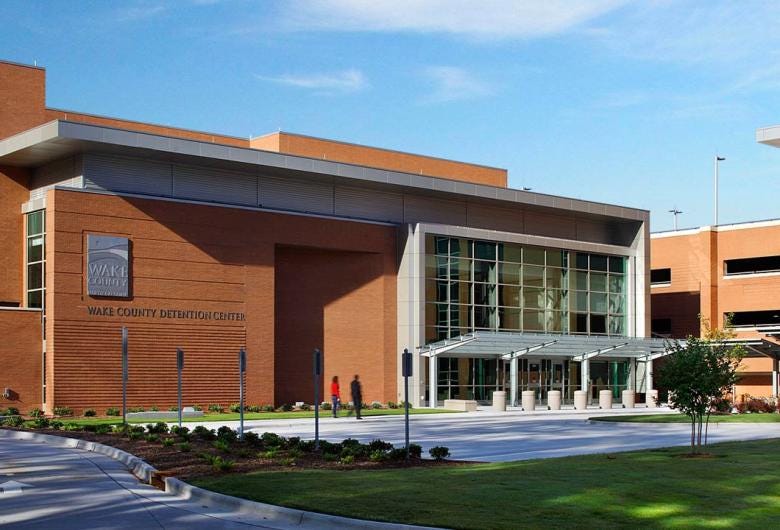
Raleigh, NC, Jul. 7, 2026 — Wake County’s jail population has already climbed beyond the figures presented to county commissioners, and District Attorney Lorrin Freeman says the county now has the lowest prosecutor-to-caseload ratio in North Carolina. Together, she said, those trends are placing increasing pressure on a criminal justice system that continues to process more than 100,000 criminal cases each year while defendants spend more time in custody awaiting resolution.
Freeman shared the update (document) on Monday during a meeting of the Wake County Board of Commissioners’ Public Safety Committee. She said 1,780 people were being held in the Wake County Detention Center as of the meeting, already exceeding the 1,697 year-to-date average shown in presentation materials prepared for commissioners.
The increase continues a trend that has been building for years. According to data presented during the meeting, Wake County’s average daily jail population has grown from 821 inmates in 2000 to a year-to-date average of 1,697 this year, an increase of 107%. At the same time, the average length of stay has risen from 19.8 days in 2001 to 36.4 days so far this year, meaning people are remaining in custody significantly longer than they did two decades ago.
Freeman said the growing jail population is occurring as the District Attorney’s Office struggles with a prosecutor shortage unmatched anywhere else in the state. A workload study conducted with the National Center for State Courts concluded that Wake County needs 69.7 assistant district attorneys to handle its current caseload. The office currently has 44 prosecutors, leaving a shortfall of nearly 26.
“We are now the lowest end in the state in terms of prosecutors to caseload,” Freeman told commissioners.
Freeman said the North Carolina Conference of District Attorneys, citing the statewide workload study she chaired in 2022, asked the General Assembly this year to prioritize funding for new prosecutors in districts with the greatest need. Wake County did not receive additional positions.
Instead, legislation enacted under Iryna’s Law (Session Law 2025-93) funded 10 new assistant district attorney positions and 5 legal assistants for Mecklenburg County while increasing the district’s authorized staffing levels. Freeman cited the law as an example of the gap between Wake County’s documented staffing needs and the resources ultimately provided by the state.
She also said Iryna’s Law has contributed to longer jail stays. Ratified by the General Assembly in September 2025 and signed by Gov. Josh Stein the following month, the law created a new category of “violent offense” and established a rebuttable presumption against pretrial release for defendants charged with those offenses. Most of its pretrial release provisions took effect Dec. 1, 2025. In many cases, judges must now order those defendants held unless the presumption against release is successfully challenged.
Despite the staffing shortage, Freeman said the District Attorney’s Office continues to manage one of North Carolina’s busiest criminal dockets. The office handles more than 100,000 criminal filings annually, with roughly 10% involving felony charges. As of Monday’s meeting, approximately 105,000 cases had been filed while about 110,000 had been resolved. The average criminal case is completed in just over six months, although homicide prosecutions typically take about two years.
Freeman credited Wake County’s implementation of electronic case filing in 2023 with helping the court system recover from pandemic-era backlogs. Wake was one of four pilot counties selected for the statewide rollout. She also highlighted several pretrial reforms implemented in recent years, including expanded pretrial support services, a magistrate first-appearance tool, and defense counsel during first appearances. Wake County was later selected as a national learning site for pretrial justice reform.
Wake County has also provided additional support to the District Attorney’s Office by funding two legal assistant positions in last year’s county budget. Those positions were assigned to the domestic violence felony unit and the Special Victims Unit, which handles child sexual abuse and related cases. Freeman thanked commissioners for that investment but said additional state or county resources will likely be necessary if Wake County is to close the staffing gap identified by the workload study.
For Wake County residents, the issues extend well beyond staffing levels. As jail populations continue to grow and prosecutors manage increasingly heavy caseloads, the pressure affects how quickly criminal cases move through the courts, how long defendants remain in custody before trial and how efficiently the county’s justice system can respond to both victims and the accused. Freeman said she wanted commissioners to understand those challenges as they consider future public safety priorities and funding decisions.