
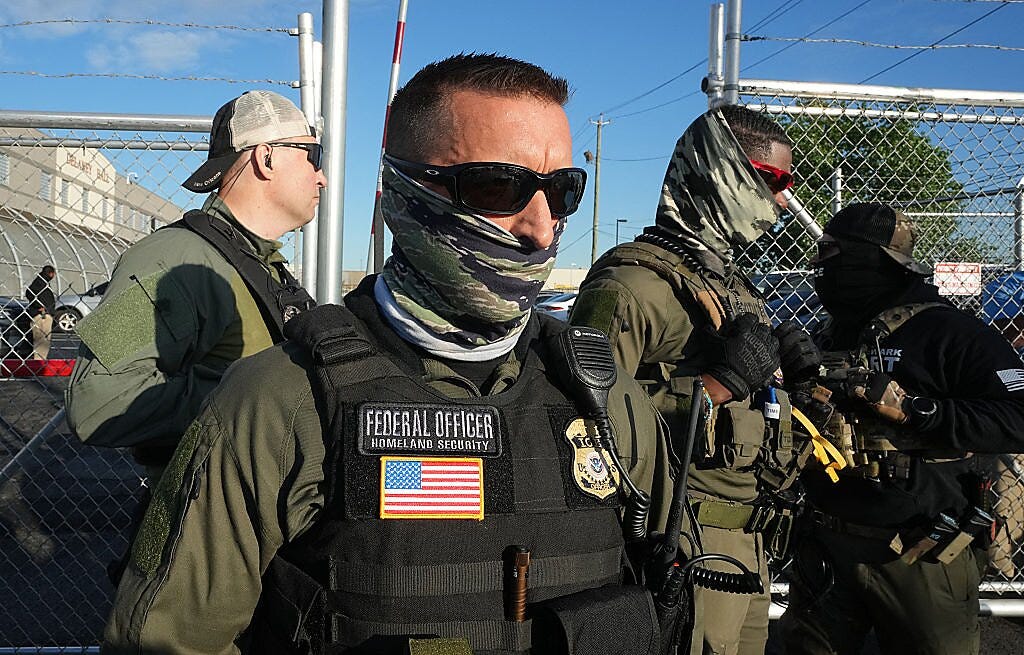
Holly Springs, NC, Jan. 10, 2026 — When authorities appear masked in public-facing situations, whether during enforcement actions or crowd control, the explanation is usually straightforward. Masks are worn for safety, to reduce health risks, or to protect against harassment or retaliation. In some cases, they are standard equipment.
But masks do more than serve a practical purpose. In the United States, they also carry meaning. That meaning has been shaped over decades by history, experience, and the exercise of power in public spaces. As a result, the sight of masked authority can elicit responses that extend well beyond the stated rationale.
The scrutiny stems from the fact that masks are not culturally neutral. Masked and hooded figures have long been associated with intimidation, violence, and the exercise of power without accountability. Those associations remain part of the public’s collective memory, and they influence how similar imagery is understood today, regardless of intent.
Public reaction, then, is not just about policy. It is also about expectations. In a democratic society, authority has traditionally been visible. Faces are seen. Individuals are identifiable. Responsibility can be assigned. When faces are covered, familiar cues are harder to discern, and trust becomes more difficult to sustain.
Rules governing the use of masks vary widely. Some agencies require badge numbers or other identifying information to remain visible. Others limit masking to specific situations, such as tactical operations, hazardous environments, or public health emergencies. In many cases, accountability exists, but it is addressed internally rather than in ways that are readily visible to the public.
Those who support masking point to a changing reality. Officers and other authorities now operate in an environment in which encounters are recorded, shared, and analyzed online. Doxxing and threats against families are no longer rare. From that perspective, masks are viewed as protective rather than provocative.
Context also matters. A mask worn during a wildfire response or a hazardous materials incident is generally understood differently than one worn during protest policing or crowd control. Public reaction often turns on whether the mask is perceived as necessary for safety or as symbolic of something else.
Critics argue that institutions exercising public power must consider not only what they do but also how they appear while doing so. They emphasize that trust depends on more than legality. Visibility, identification, and accountability all play a role, especially in interactions that unfold in public view.
The result is a familiar tension. What authorities see as a reasonable safeguard can, to others, appear as distance or unaccountable power. That gap in perception helps explain why the use of masks often becomes controversial before any specific action is judged on its merits.
As expectations around transparency continue to evolve, the challenge for institutions is not simply deciding when masks are justified. It is deciding how to balance safety with visibility, and protection with accountability. How that balance is struck may matter as much as any single enforcement decision.
Editor’s Context Note
This explainer looks at how the use of masks by authorities is shaped by history and public expectations, rather than focusing on any single agency or incident.
About the Author
Christian A. Hendricks is the publisher and founder of Holly Springs Update, a local news publication covering Holly Springs, NC, and its surrounding area. From time to time, he shares his views on national, regional, and state issues. He can be reached via email at christian.hendricks@hollyspringsupdate.com.