

Holly Springs, NC, July 14, 2026 — North Carolina’s new state budget gives public school teachers raises ranging from 5.5% to more than 17% at the experience levels examined, substantially exceeding the 3% increase Wake County Public Schools used when building its 2026-27 budget.
For teachers, the largest increase goes to those just entering the classroom. A first-year teacher with a bachelor’s degree will earn $4,800 a month, up from $4,100 during the 2025-26 school year, a $700 monthly increase, or 17.1%. The percentage increase declines with experience, reaching 5.5% for teachers with 15 or more years of service.
The new state schedule, effective July 1st, 2026, also creates a local budget question for Wake County, which fully funded a school system spending plan built around a salary assumption that no longer matches the raises enacted by the state.
Teacher Raises Vary Sharply by Experience
A teacher with five years in the classroom will see a monthly state base pay increase from $4,475 to $4,950, a 10.6% raise. At 10 years, pay increases from $4,935 to $5,314, a 7.7% increase.
Teachers with 15 to 24 years of experience will move from $5,388 to $5,682 a month, a 5.5% increase. Those with 25 or more years will also receive a 5.5% increase, with monthly pay rising from $5,595 to $5,900.
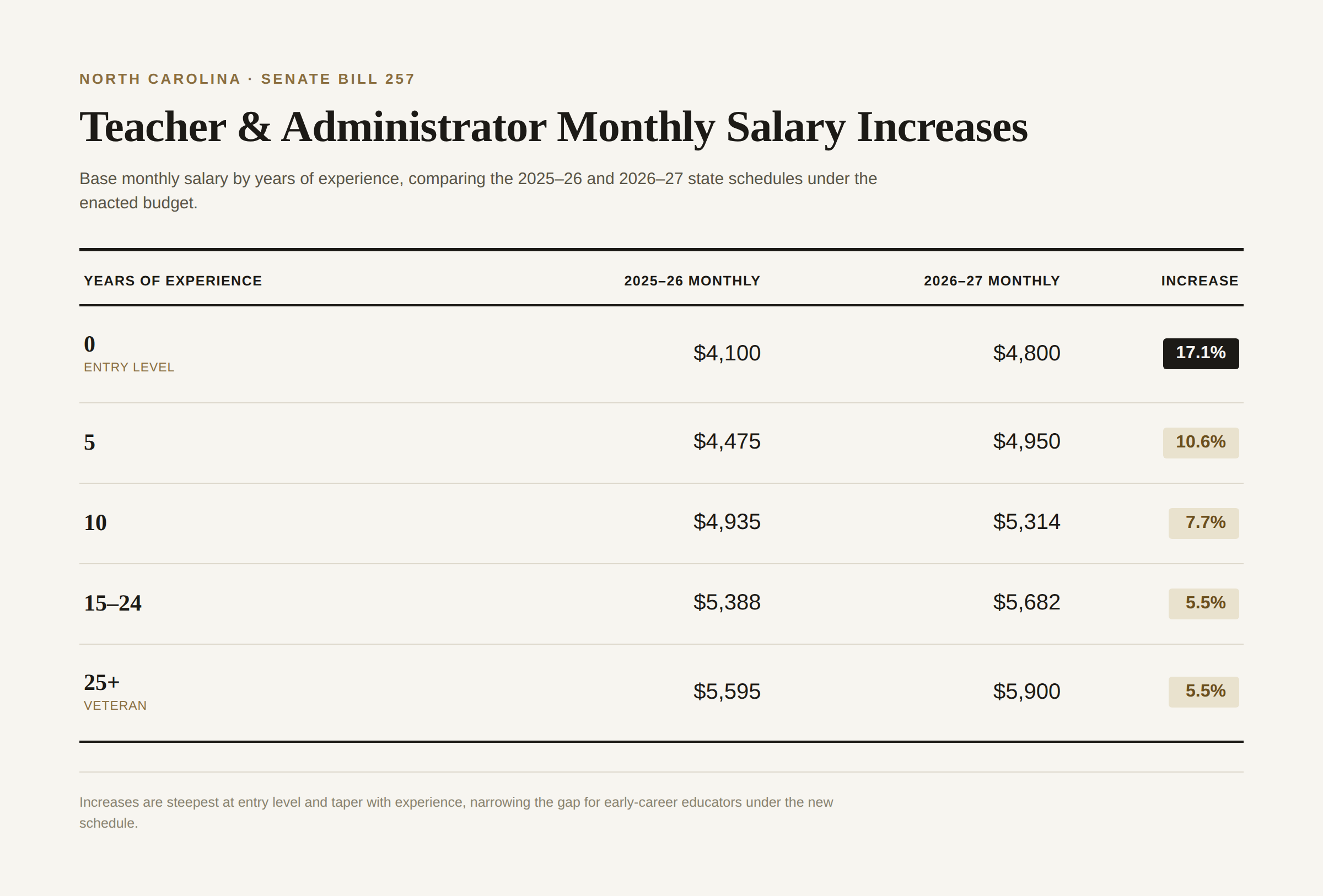
The result is a salary schedule weighted heavily toward the beginning of the teaching career ladder. Beginning teachers receive the largest percentage increase, while the size of the raise declines as years of experience accumulate.
Assistant principals will move to a new state salary structure tied to the teacher salary scale plus 19%, replacing the previous degree-based pay bands. Principals, superintendents, and central office staff receive a flat 3% state increase, resulting in significantly different pay outcomes depending on an employee’s position and, for teachers, years of experience.
Wake County Budgeted for a Different Outcome
When WCPSS developed its 2026-27 budget, the final state salary decisions were not yet known. The district therefore assumed a 3% state-legislated salary increase for all employees and estimated that assumption would require $42.56 million for employees paid through the State Public School Fund and Local Current Expense Fund.
Of that amount, WCPSS expected $34.72 million to come from the state and budgeted $7.84 million in local funding. The district separately requested a $25.3 million increase in local funding from Wake County for Fiscal Year 2027, which the Wake County Board of Commissioners fully funded without adjustments when it approved the county budget on June 1st.
That timing matters. Wake County fully funded the school system’s request, but it was built before the final state salary schedule was known and based on a 3% salary assumption that no longer matches the raises enacted for teachers.
The larger teacher raises do not necessarily mean Wake County must locally fund the full difference between the 3% assumption and the final state salary schedule. The state is responsible for funding the salary schedules it establishes for state-funded school positions, so much of the additional cost should be covered by state funding.
The local effect is more complicated because WCPSS also employs people with local funds, and its budget includes local salary and benefit costs tied to employee compensation. The district will now need to apply the final state legislation to its actual mix of state-funded and locally funded employees and determine how the new salary schedules change the $7.84 million in local costs it budgeted under the original assumption.
If the new schedules create additional local costs, WCPSS could potentially absorb them through existing budget flexibility, fund balance, or other spending adjustments. If the difference cannot be absorbed, additional county funding could become another option. WCPSS has not yet indicated whether any of those steps will be necessary, and a revised fiscal analysis will be needed to determine the actual local impact.
Wake County’s local compensation plan adds another layer. WCPSS budgeted a 1% increase to its locally funded salary supplement tables for certified staff and assistant principals, at an additional cost of approximately $1.91 million. Because the increase applies to the supplement tables, it does not mean eligible employees receive another 1% of their total salary on top of the state raise.
The district also budgeted $2.36 million to continue locally funded master’s and advanced-degree pay for newly hired teachers and other certified personnel who are not eligible for state-funded advanced-degree pay. That is not a general salary increase but represents another locally funded component of employee compensation.
North Carolina Still Trails the Nation
The raises come as North Carolina continues to rank among the lowest-paying states for teachers. According to the National Education Association’s Rankings of the States 2025 and Estimates of School Statistics 2026, North Carolina’s average teacher salary was $60,323 during the 2024-25 school year, tying the state for 43rd among the 50 states and the District of Columbia.
The national average that year was $74,495, meaning the average North Carolina teacher earned about $14,000 less than the national average. North Carolina’s average salary also remained closer to some of the nation’s lowest-paying states than to several of its neighbors, with Mississippi averaging $54,975, Florida $56,663 and Louisiana $56,785.
Neighboring states have continued to increase teacher pay. Georgia teachers averaged $71,524 in 2024-25, an increase of 1.73% from the previous year; Virginia’s average reached $69,254, up 4.41%; and South Carolina climbed 5.41% to $64,050.
Even after North Carolina’s new salary schedule takes effect, the state’s average is likely to remain below all three neighboring states because the largest increases are concentrated among beginning teachers rather than spread evenly across the full workforce.
The national target is also continuing to move. The NEA estimates that the average U.S. teacher salary will rise from $74,495 in 2024-25 to $76,552 in 2025-26, an increase of 2.76%, while overall instructional staff salaries are projected to increase 2.72% to $78,702.
Those increases have not been enough to keep pace with inflation over the past decade. The national average teacher salary increased 28.2% in current dollars between 2016-17 and 2025-26, climbing from $59,722 to an estimated $76,552, but adjusted for inflation, that represents a 4.6% decline in purchasing power.
North Carolina also spends less per student. The state spent $13,640 per student in current expenditures during the 2024-25 school year, compared with a national average of $17,840, while its student-teacher ratio of 15.2 was nearly identical to the national average of 15.1.
Together, those figures show that North Carolina’s lower per-student spending is not simply the result of having fewer teachers per student. The state spends less per student while also paying its average teacher substantially less than the national average.
A New Calculation for Wake County
For beginning teachers, the new state salary schedule represents a substantial increase. A $700 monthly increase in state base pay could make North Carolina more competitive for educators at the beginning of their careers, even as the percentage increase falls considerably for veteran teachers.
For Wake County, the immediate question is no longer whether commissioners fully funded the school system’s budget request; they did. The question is how the district’s actual local salary costs change now that the state enacted a teacher pay plan substantially different from the 3% assumption used to build that budget.
WCPSS will now need to reconcile the new state salary schedules with the funding already approved for the 2026-27 school year. Until that calculation is complete, the magnitude of any additional local costs and whether the district can absorb them within its existing budget remain unclear.