
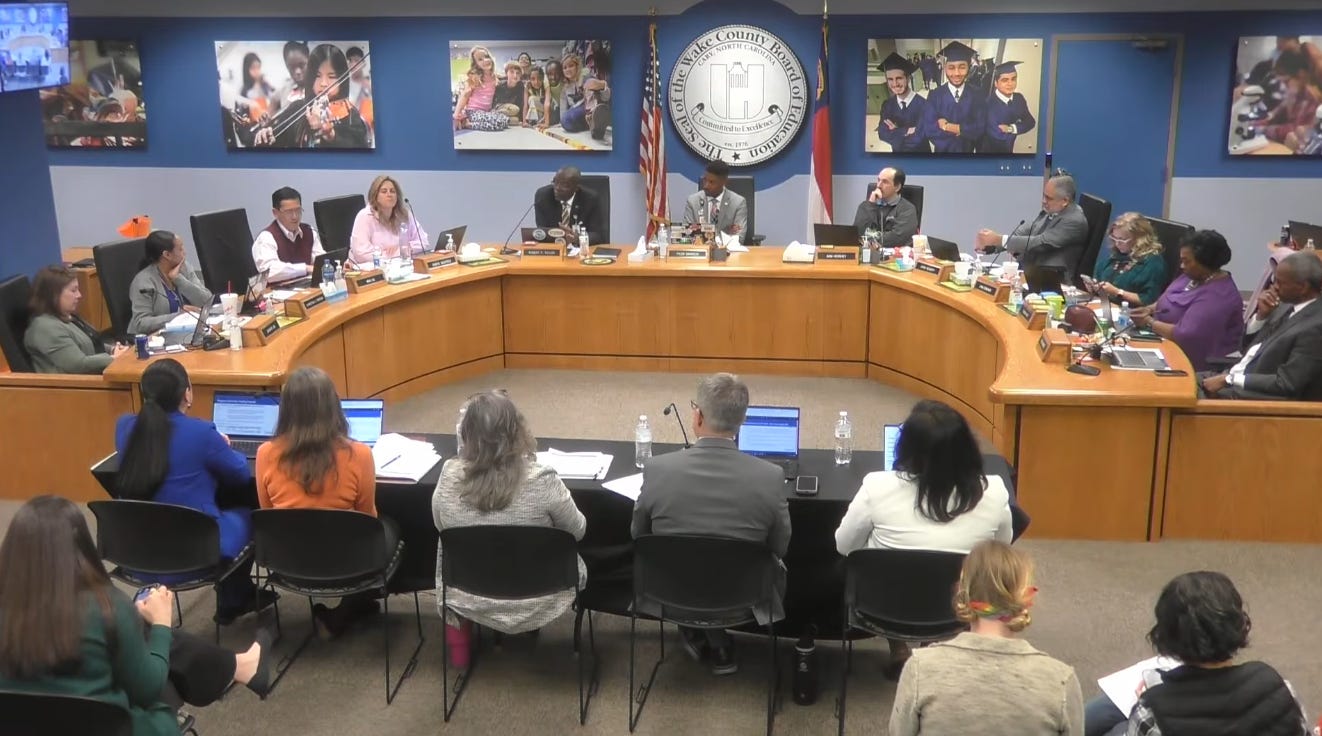
Cary, NC, Mar. 25, 2026 — The Wake County Board of Education convened a special-called meeting yesterday with a clear purpose: to get answers from district administration.
In the days leading up to the meeting, board members and district leadership were inundated with emails from teachers, parents, and community members. At the center of that concern was a number that spread quickly and widely, an $18 million deficit tied to special education. It became the focal point of conversation, frustration, and in many cases, fear about what might be coming.
“This meeting is about getting answers,” one board member said at the outset, underscoring the board’s oversight role and the expectation that district leadership would provide clarity.
As the meeting unfolded, however, a different picture began to take shape. There is no current deficit. What the district is facing instead is a forward-looking structural gap, one that has developed over time and now requires adjustment.
That distinction would prove to be at the center of both the financial discussion and the tension in the room.
The District’s Framing
Early in the meeting, district leadership sought to reset the narrative and address what had quickly become the central concern.
The message was direct. The special education program is expected to end the year with a positive balance. The issue, as presented, is not about immediate cuts, but about aligning costs before a future shortfall emerges.
“We are not in a negative position,” was emphasized during the overview. At the same time, leadership acknowledged that continuing current staffing and program levels without adjustment would eventually exhaust available federal funding.
“If we do the exact same thing programmatically this year, then the IDEA grant would run out of money,” was shared during the presentation.
The overview also addressed one of the most widely circulated concerns, clarifying that the district is not eliminating 130 teachers. Instead, staffing changes are expected to occur through attrition and caseload adjustments.
Equally important, leadership reinforced that services to students will continue. Requirements tied to individualized education programs will remain in place, and services cannot be reduced due to funding constraints.
“There will be no change in our requirement to implement students’ IEPs,” was stated during the presentation.
Taken together, the overview was intended to provide clarity and reassurance. But as the discussion progressed, it became clear that the explanation did not fully align with how the situation had been previously communicated or understood.
What Actually Happened
At its core, the issue is not complicated. It is a dynamic that would be familiar in any organization managing a budget over multiple years.
Several years ago, the district received a significant increase in federal special education funding. Some of that funding arrived late in the fiscal year, which created an unusually large carryover balance that rolled forward into future years. That carryover, at times reaching between $20 million and $30 million, provided a level of financial flexibility that had not previously existed.
At the same time, student needs were increasing. The district was growing. More students required services, and those services were not optional. In response, the district added staff, expanded support, and increased service levels for students with disabilities.
Those decisions were understandable. The need was real, the services were required by law, and the funding appeared to support it. But the nature of that funding differed from the costs it supported. The funding increase was temporary. The costs were not.
The Slow Build to a Structural Problem
For several years, that mismatch remained largely hidden. The district relied on the carryover to bridge the gap between ongoing expenses and incoming funding. Each year, spending exceeded new revenue, but the difference was absorbed by prior-year balances.
That approach worked until it didn’t.
As the carryover began to decline, the underlying structure became more visible. What had once been a buffer began to shrink, dropping from roughly $30 million to under $20 million, and is now projected to fall to $2 to $5 million.
If nothing changes, the district would eventually run out of available funding before the end of the next fiscal cycle. That projected gap is what ultimately became associated with the $18 million figure.
What Should Have Been Said
As the discussion unfolded, it became increasingly clear that the issue was not just financial. It was also about how the situation had been communicated.
What many people heard was that the district had an $18 million deficit in special education. That framing suggested an immediate crisis, something already in motion and requiring urgent corrective action.
What should have been said was something more precise and, ultimately, more accurate. The district does not have a deficit today. However, because temporary funding was used to support ongoing expenses, adjustments are now required to avoid a projected shortfall next year.
District leadership acknowledged that the message had not been communicated clearly. “We needed to do a better job in communicating the fiscal status,” was shared during the meeting.
That distinction carries weight. One describes a system already in trouble. The other describes a system that still has time to adjust. When that difference is not clearly made, it changes how staff, families, and the broader community understand what is happening.
In this case, it also shaped the tone of the conversation before the meeting ever began.
What Changes and What Doesn’t
Throughout the meeting, district leadership emphasized that services to students will not be reduced. Individualized Education Programs, which are legally required, will continue to be implemented as written.
Self-contained classrooms and related services, including speech and occupational therapy, are not being eliminated. The changes are expected to come primarily through staffing structure, specifically through adjustments to caseloads for certain special education teachers.
In practice, that means fewer positions funded through the federal grant and more students assigned per teacher, with schools given flexibility in how they implement those adjustments based on student needs.
The commitment is that services will still be delivered. The question is how those services are distributed and supported within the available funding.
A Broader Context: Pressure Beyond the District
The conversation also took place within a larger context that continues to shape public education in North Carolina. The state ranks near the bottom nationally in per-pupil funding, and the current fiscal year began without a fully adopted state budget.
At the same time, salary increases for educators were approved without corresponding increases in state funding, leaving districts to absorb those costs. These pressures do not create this specific issue, but they do narrow the margin for error and increase the importance of long-term planning.
Where Accountability Lands
As the meeting progressed, the conversation shifted toward accountability. The financial explanation was detailed, but board members' frustration centered on the timing, clarity, and consistency of the information.
“I need facts, and I need the truth,” one board member said during the discussion, capturing the broader concern about conflicting information reaching both the board and the public.
The issue itself developed over several years. It was identified internally in the fall. But the way it was communicated, both in language and in timing, created inconsistency that carried into the public conversation and ultimately into the boardroom.
Questions were raised about who knew what and when, how decisions were made to fund recurring costs with temporary dollars, and why the situation was not more clearly explained earlier. Those questions were not fully resolved in the meeting, but they framed the discussion moving forward.
What Comes Next
The superintendent is expected to present a proposed budget in early April. That proposal will include the adjustments needed to align ongoing costs with available funding while maintaining required services for students.
The financial challenge is real, but it is also manageable. The more immediate challenge may be restoring clarity and trust in how that information is communicated.
As was noted at the outset of the meeting, the community is watching. The outcome of this process will shape not only the budget but also confidence in how decisions are made and explained in the months ahead.