
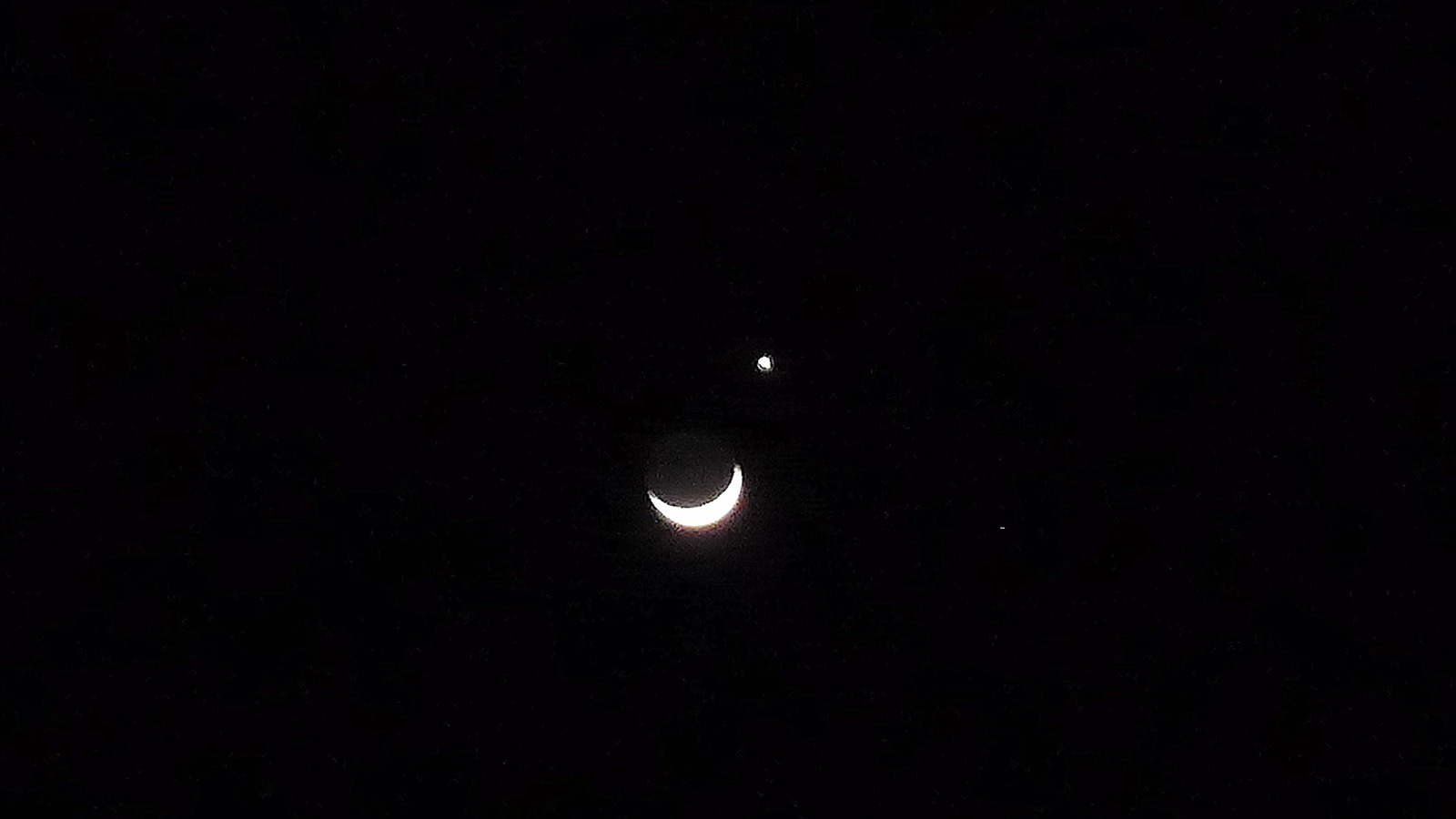
Holly Springs, NC, July 16, 2026 — Residents in Holly Springs, Apex and Fuquay-Varina who step outside shortly after sunset Friday could catch one of the summer’s most striking astronomical sights as a thin crescent Moon appears alongside Venus in the western sky. The pairing, known as a conjunction, will be visible between 9 and 9:30 p.m. EDT, about 30 to 60 minutes after sunset.
To find it, look low toward the western horizon. Venus, often called the “Evening Star” despite being a planet, will be the brightest object in that part of the sky, while the slender crescent Moon will appear about 6 degrees to its left. No special equipment is needed to enjoy the display, although a pair of binoculars can reveal additional detail and allow both objects to be viewed together in a single field of view.
Skywatchers should also look for earthshine, the faint glow illuminating the Moon’s dark side. The phenomenon occurs when sunlight reflects off Earth and softly lights the portion of the Moon not directly illuminated by the Sun, making it most noticeable during thin crescent phases shortly after sunset or before sunrise.
A conjunction occurs when two celestial objects appear close together in the sky from Earth’s perspective. The objects are not actually close to one another in space; they simply line up along our line of sight as the Moon and planets travel across similar paths in the sky. Moon-planet conjunctions are relatively common because the Moon completes an orbit around Earth about every 27 days, passing each of the visible planets roughly once a month, although each conjunction looks slightly different depending on the objects’ positions and viewing conditions.
For the best view, head to a location with an unobstructed western horizon and clear skies. Begin looking between 9 and 9:30 p.m., find brilliant Venus first, then locate the thin crescent Moon just to its left. The celestial pairing will remain visible for only a short time before both objects sink below the horizon later in the evening.