
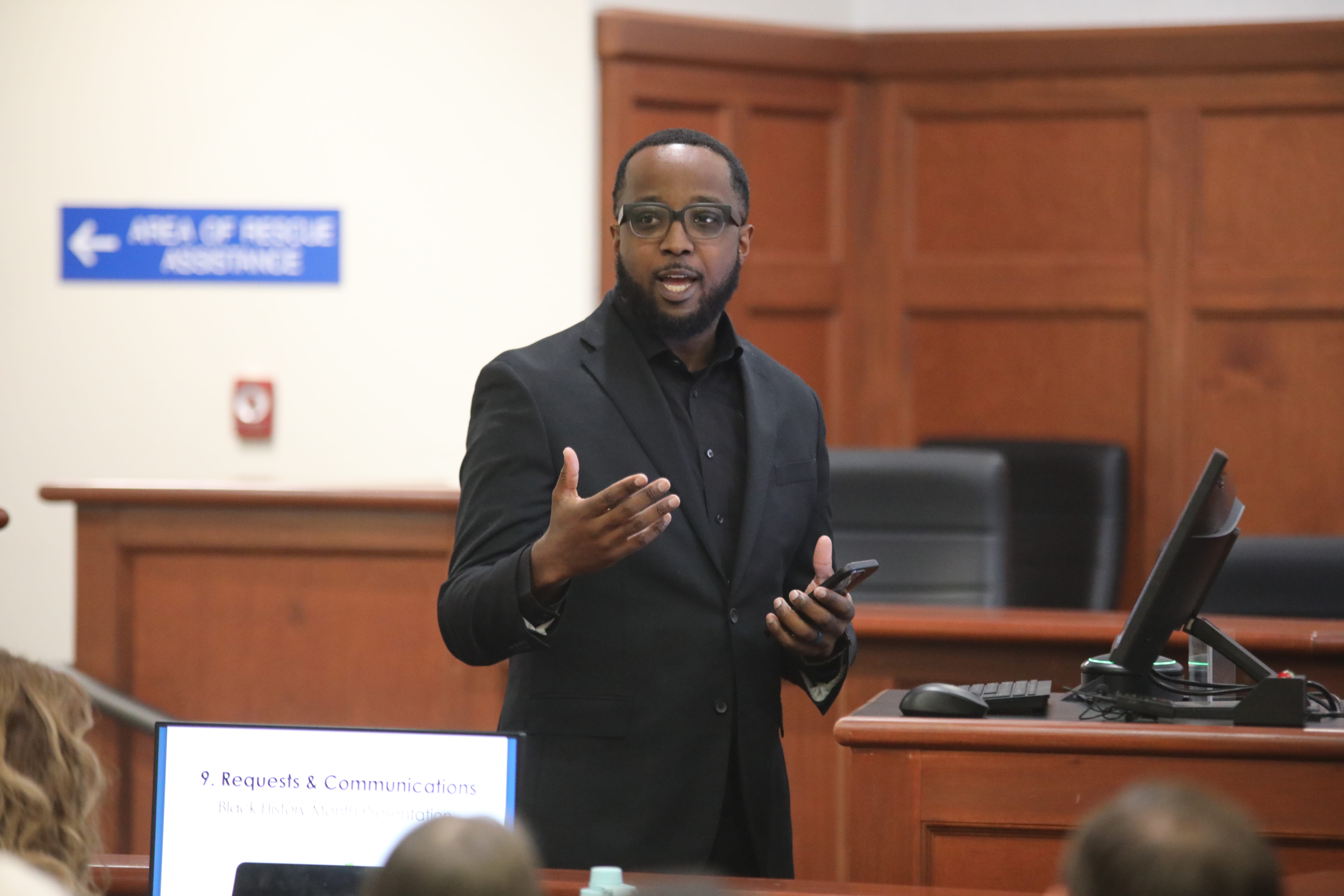
Holly Springs, NC, Feb. 21, 2026 — Rapid growth and traffic often dominate conversations about the Holly Springs’ future.
But during last Tuesday’s Town Council meeting, speakers reminded residents that the town’s story stretches much further back than most know, and that Black residents' contributions helped shape Holly Springs long before its population surge.
Tuesday’s meeting began with a series of recognitions, including Mayor Mike Kondratick’s proclamation of March as Women’s History Month, where he highlighted the role women have played in strengthening communities both nationally and locally. His remarks pointed to the legacy of Black women in Holly Springs’ civic life, including leaders such as former commissioner Bernice Lassiter and others whose contributions helped guide the town through earlier decades of change.
Later in the meeting, council members heard a deeper reflection on Holly Springs’ Black history from Pastor Jahmar Cobb, a lifelong resident and pastor of Oak Grove Missionary Baptist Church, whose remarks focused on the lived experiences, neighborhoods, and institutions that defined the town’s early Black community.
A Town That Began Before It Was Incorporated
Cobb reminded the council and meeting attendees that while Holly Springs was officially incorporated in 1876, the town’s roots extend further back.
Before growth rankings, subdivisions, or bypasses, Holly Springs formed around a crossroads near freshwater springs and holly trees, a place where travelers stopped, and families settled. Long before modern development, Cobb said, the area functioned as a small agricultural hub where Black families farmed, worshiped, and built tightly connected communities.
After church services, residents often gathered at the home of Dr. George and Gladys Grigsby, figures Cobb described as cultural anchors whose influence still echoes in the town’s geography and institutions.
“Community here was not transactional,” Cobb said. “It was relational.”
Communities Before Subdivisions
Cobb painted a picture of Holly Springs before planned developments and branded neighborhoods.
Long before 12 Oaks, Sunset Oaks, or Holly Glen, he said, communities such as Eastern Acres, Holly Acres, West Holly Springs, Utleytown, and Prince Town defined the town’s landscape.
“These communities did not have brick entrances… or glossy brochures,” Cobb told council members. “But there was grit, there was vision.”
Those communities, he said, produced educators, entrepreneurs, public officials, and law-enforcement leaders — evidence that the town’s foundation was built by residents who believed in Holly Springs even when opportunity was limited.
Education and Leadership Shaped Generations
Cobb also traced the role of education in shaping Holly Springs’ Black community.
He noted that the land where the Hunt Center stands today once hosted a Rosenwald school that educated Black children during segregation — a place he described as helping guide a generation toward opportunity and leadership.
From those beginnings came milestones that reshaped local leadership:
William Lassiter and James Norris became the town’s first Black commissioners.
Nancy Womble became the first Black woman elected to the Board of Commissioners.
Norris later became Holly Springs’ first Black mayor.
Dessie Mae Womble went on to become North Carolina’s first Black female police chief.
For Cobb, those achievements reflect a community that steadily expanded opportunity even when formal structures lagged behind.
“This Is Not Just Black History — It’s Our History”
Cobb closed by urging council members and residents to view Holly Springs’ Black history not as a separate chapter, but as central to the town’s identity.
“This is not just Black history,” he said. “This is [our] history.”
Understanding those roots, he added, is essential as the town continues to grow and change.
Why It Matters Today
As Holly Springs expands, new neighborhoods and infrastructure often define how the town is perceived.
But the council’s discussion served as a reminder that the community’s foundation rests on earlier generations of farmers, educators, church leaders, entrepreneurs, and public officials who shaped Holly Springs long before it became one of the state’s fastest-growing towns.
The story of Holly Springs did not begin with development.
It began with people.
Learn More…
Holly Springs’ Black History Tour (link)
Holly Springs’ Black Civic Leaders (link)
Holly Springs Rosenwald School (aka Holly Springs Colored Elementary School (link)
Honoring Black History in Holly Springs: Lassiter House (link)
Honoring Black History in Holly Springs: The Pack-House (link)
Honoring Black History in Holly Springs: United Church of Christ (link)
Honoring Black History in Holly Springs: Holly Springs Elementary School (link)
It is sad many things Pastor Cobb highlighted as historic are no longer here. Holly Springs continues to erode the history of what it once was, even when the Comprehensive Plan states they intend to preserve the small town charm and history. So the Black history is only memories written down on the town website and in the hearts of those who remember!
Developers come in and the town staff encourages them to increase the density on their plans, the Town Council approves development with clear plans for tree protection and the staff subsequently approves the clear cutting of the parcel, natural areas set on the future land use plan as “to be preserved” are allowed to be demolished in favor of more housing, etc.
What is happening is detrimental to Holly Springs, and those who recently ran for town council stated they would fix the problems. Their record has begun and they are following suit with increased density, increased traffic, and blatant disregard for the rule of law!
Wait until ppl hear about MM Prince, who owned half the town. Whose heirs built 2 subdivisions, one cut in half by 55. Who is currently buried behind Prince funeral home. Don’t hear much about him or his heirs.