
Holly Springs, NC, Sep. 7, 2026 — The U.S. conflict with Iran has lasted more than six months. Whatever judgment history ultimately makes about the decision to fight it, the war has provided a useful test of assumptions Americans have made for decades about U.S. military power.
The United States can move aircraft carriers, bombers, fighters, submarines and thousands of military personnel halfway around the world. It maintains military facilities across the globe and fields weapons few countries can match. But ships sent to one part of the world aren’t available somewhere else, and sophisticated weapons can be fired much faster than American factories can replace them.
286 days at sea
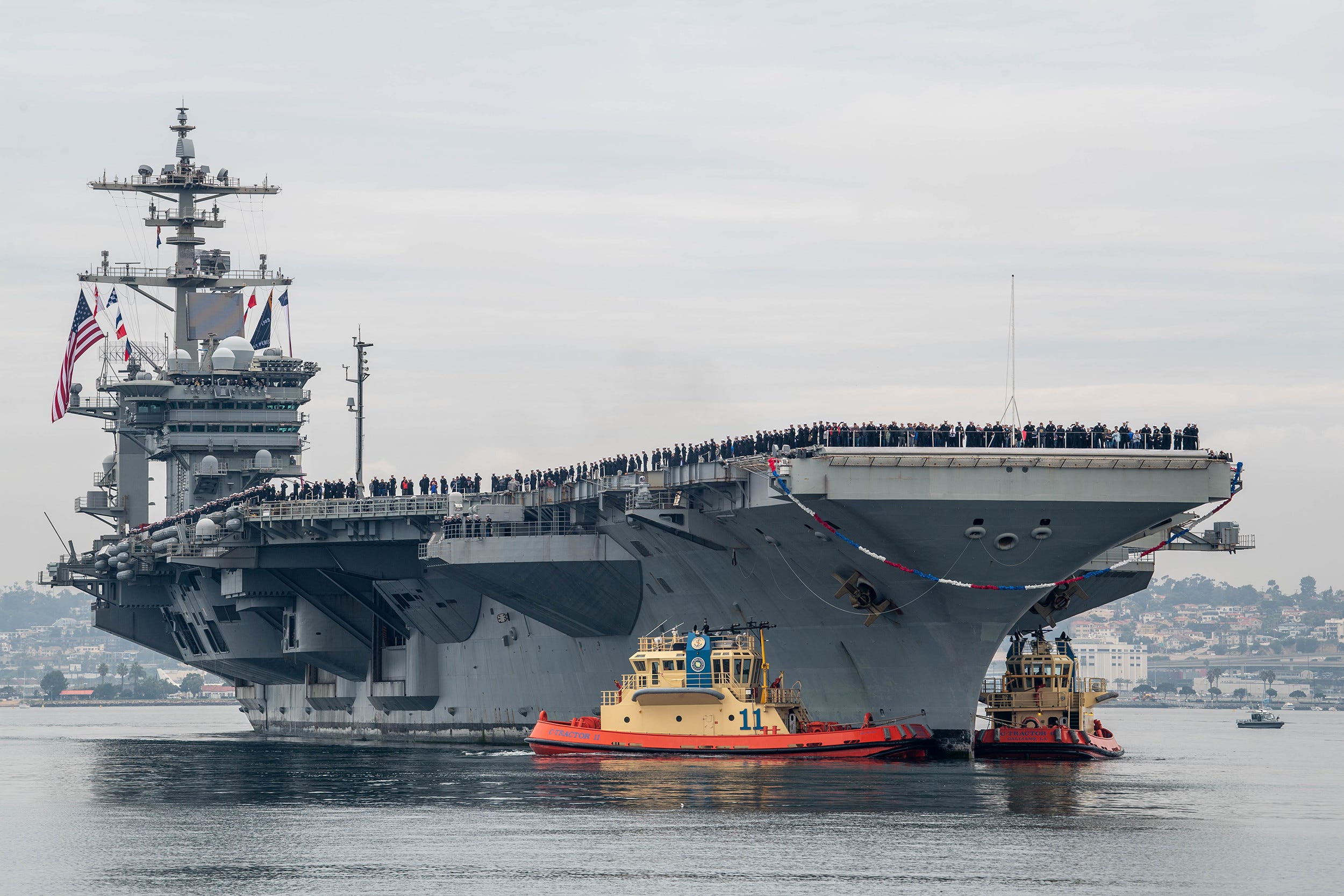
The USS Abraham Lincoln left San Diego on November 21st, 2025, for what began as an Indo-Pacific deployment. It was redirected toward the Middle East in January as tensions with Iran escalated and spent much of the following months supporting combat operations.
When the Lincoln arrived in Thailand on September 2nd, its roughly 5,000 sailors and Marines had spent 286 consecutive days at sea, according to Reuters. Reports during the deployment raised concerns about living conditions and the physical and mental strain on the crew. U.S. Defense Secretary Pete Hegseth has disputed reports portraying conditions aboard the carrier as poor.
The Navy once worked under a very different standard. In 1985, it established a 180-day deployment limit as part of an effort to control operating tempo and the amount of time sailors spent away from home. Six months remained the traditional deployment model for years afterward.
There were more carriers then, too. The Navy had 14 in 1989 and briefly reached 15 in 1991. Six participated in Operation Desert Storm, with deployments among those carriers running roughly six to eight months. The United States has 11 carriers today. Since the October 7th, 2023, Hamas attack on Israel, carrier deployments have averaged about 8 1/2 months, according to the U.S. Naval Institute’s carrier deployment database.
Having 11 carriers does not mean all 11 are readily available for deployment. At any given time, some are undergoing maintenance, others are training for deployment and others are returning from sea.
When it came time to relieve the Lincoln, the Navy sent the USS George Washington, the carrier based in Japan, to the Middle East. The George Washington had been operating in the South China Sea shortly before moving west. The Navy found another carrier for thecIranian conflict, but it came from the region where the United States faces China.
The missile problem
The Iran conflict has also consumed substantial quantities of American munitions, particularly interceptors used against ballistic missiles and drones.
We don’t know exactly how many. The inventories are classified, published estimates vary and the Pentagon has challenged some of the higher figures. The Atlantic Council reported in August that estimates suggested the conflict may have consumed as much as three-fifths of U.S. Patriot interceptor stocks and roughly half of THAAD interceptor inventories. Those are estimates, not Pentagon inventory figures.
The Associated Press later reported that Patriot inventories available in Europe had fallen to levels some officials described as “beyond critical.” The Defense Department disputed that description and said reports about the severity of the shortage were misinformed.
The disagreement over the numbers doesn’t change how long replacement takes. Experts cited by the Atlantic Council say fully replenishing some stocks could take years. A missile can be fired in seconds. Building its replacement requires a factory, workers, components and time.
For much of the past few decades, the United States fought opponents that could not challenge it on anything approaching equal technological terms. It became easy to think about military strength in terms of how much Washington was willing to spend. Congress can appropriate billions of dollars in an afternoon. The weapons still have to be built.
Iran doesn’t have to match us
Regional adversaries still can’t match the United States technologically across the board. They don’t need to.
Drones, precision missiles, satellite imagery and modern air defenses give smaller countries capabilities that once belonged mostly to major powers. Some relatively inexpensive drones and missiles can require much more expensive interceptors to destroy them. More important in a prolonged fight, those interceptors may take far longer to manufacture than the weapons they are being used against.
Iran also has the advantage of fighting close to home. China would have the same advantage in a war over Taiwan, as would Russia in a conflict along NATO’s eastern flank. Land-based missiles, aircraft and drones can operate from nearby territory and be supplied over relatively short distances.
American forces have to cross oceans and then keep fuel, ammunition, spare parts and people moving across those distances for as long as the fighting continues.
That matters because Iran is not the most demanding military challenge the United States is preparing to face.
What if Taiwan comes next?
Iran’s economy and conventional military are substantially smaller than America’s. It doesn’t have a comparable navy or air force, and it doesn’t maintain a worldwide network of military bases. Even so, months of fighting have put demands on carriers, interceptor inventories, sailors and weapons production.
If China moved against Taiwan while substantial American forces remained committed in the Middle East, some U.S. ships would already be deployed and some weapons already expended. American factories would already be replacing equipment used in another theater.
No one can look at the Iran war and know how a simultaneous conflict with China would end. We can see how quickly a prolonged regional war begins using resources that might be needed somewhere else.
How much is actually available?
The United States has 11 aircraft carriers. It spends hundreds of billions of dollars a year on defense. Both numbers say something important about American military strength.
Neither tells us how many carriers are ready to deploy today, how many months their crews can remain at sea, how many interceptors are in their magazines or how quickly those weapons can be replaced. They don’t tell us what happens to maintenance schedules when deployments run long, or what happens to another region when a carrier has to be moved.
Those questions matter regardless of whether someone wants the United States to do more or less overseas. NATO, South Korea, Japan and American policy toward Taiwan ultimately depend on having ships, aircraft, weapons and people available when they are needed.
The Lincoln can stay at sea a long time. Keeping roughly 5,000 people supplied, replacing the weapons they use and eventually finding another carrier to take their place is another matter.
In this case, the United States found one. The USS George Washington left the Pacific and went to the Middle East.
That worked. But if the next crisis is in the Pacific, where does the next carrier come from?
Christian A. Hendricks is the publisher and founder of Holly Springs Update, a local news publication covering Holly Springs, NC, and its surrounding area. From time to time, he shares his views on national, regional, and state issues. He can be reached via email at news@hollyspringsupdate.com.