
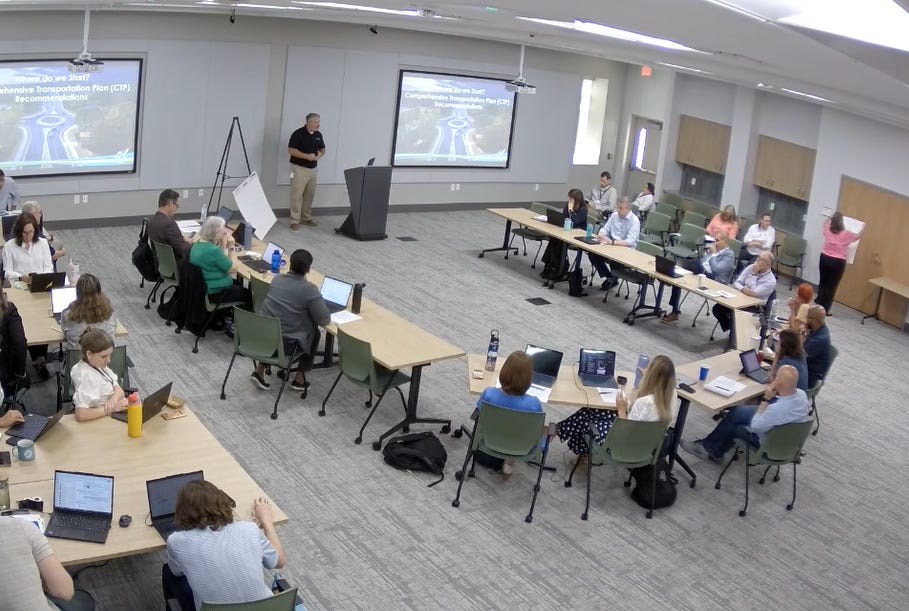
Holly Springs, NC, Oct. 5, 2026 — Town Council members leaned toward asking voters to approve a transportation bond in 2028 rather than 2027 during its council workshop last week, with town projections showing that waiting a year could add $11 million to $31 million in borrowing capacity at the current tax rate.
Council took no formal vote, and nothing has been placed on a ballot. No projects have been selected and Council has not determined the size of a potential bond. Town staff said they heard a preference for 2028 and will return with an updated schedule because planning had previously assumed a 2027 vote. General obligation bonds require voter approval.
Corey Petersohn, the town’s Budget, Innovation, & Strategic Initiatives Director, said a 2027 vote would be based on what the town knows today. The town’s debt model shows $56 million of remaining general-government borrowing capacity under that scenario. Waiting until 2028 would include another year of property valuation growth, increasing projected capacity to between $67 million and $87 million.
Both projections assume the current property tax rate of 34.35 cents per $100 of valuation and are designed to protect the town’s AAA bond rating. The estimates come after roughly $38 million set aside in the capital plan for two fire stations and their equipment and exclude a second $50 million issuance from an existing general obligation bond expected in 2027.
Petersohn cautioned against treating the $56 million figure as a minimum, saying the model is deliberately conservative and the town has tended to outperform its projections. The town can only borrow against what it knows when it issues bonds, so it can't count anticipated growth early. The available capacity is shared across general-government needs, including future facilities, so not all of it would necessarily be available for transportation.
A council member asked what tax increase would be needed to reach the projected 2028 borrowing level a year earlier. Petersohn said no firm number is available because property valuations are changing quickly, and the town's financial advisors would need to do the calculation.
The two planned fire stations would be financed separately through limited obligation bonds, which do not require voter approval and could move forward ahead of a transportation referendum. Petersohn said both forms of borrowing draw from the same capacity, and the timing of a second fire station, around 2030 to 2033, could affect when the town can fund transportation projects.
The town’s Comprehensive Transportation Plan identifies more than 150 projects representing more than $1 billion in needs. Staff and consultants from Kimley Horn analyzed about 30 projects with a combined cost of $554 million, then reduced the scope to about 23 projects costing around $150 million. The estimates are preliminary and assume the town pays the full cost without grant assistance.
Even the smaller $150 million list is well above the projected $56 million to $87 million in borrowing capacity. About $35 million, give or take, in projects already under design have no identified construction funding, according to staff.
Those projects include Holly Springs Road West, Avent Ferry Road improvements, Festival Street and a greenway. Funding all of them would leave less money for new projects. Staff said bond proceeds cannot fund transit improvements.
One council member favored a 2027 vote, saying “the sooner that money gets in the pipeline” the better and noting that the difference between 2027 and the low end of the 2028 projection was only $10 million or $11 million.
Others favored 2028, pointing to greater borrowing capacity and more time for public education. Members cited the 2018 bond, which they said included a long list of projects but resulted in only a couple being completed. One member said they would “rather see more capacity, which means better projects.”
One member worried that a transportation bond could get buried on a presidential-year ballot. A participant said the town’s bond attorney reported that bond votes are more common in presidential years.
Staff said waiting until 2028 would not change the delivery path for Holly Springs Road West, the project closest to completing design. Petersohn said projects likely to be built between 2030 and 2034 likely have not started design.
Petersohn described a reimbursement resolution that would allow the town to use fund balance cash for one or two small projects, roughly $1 million to $3 million each, and reimburse itself with bond proceeds if voters approved the borrowing. He said it could fund design work or complete a smaller project, such as an intersection or short sidewalk. If voters rejected the bond, Petersohn said, the town would have to be comfortable having spent the cash.
Council members were asked to divide a hypothetical bond among five types of transportation projects: corridors, intersections, multimodal projects, safety, and new road connections. Across three group reports, corridors and intersections received the largest shares overall, while new road connections received the smallest. Every group allocated 30 to 40 percent to corridors, with intersections receiving 25 to 40 percent.
Staff said it will combine those results and return to Council with investment scenarios. Transportation and traffic ranked as residents’ top concern in the town’s most recent statistically valid citizen survey, Town Manager Randy Harrington said.
Harrington said staff wants another Council discussion in late fall or early winter, along with community engagement. A revised schedule had not been released when the Sept. 30th workshop ended.