
Holly Springs, NC, May 20, 2026 — Holly Springs Town Council spent much of Tuesday night wrestling with the same question that has increasingly defined growth conversations across town over the last several years: whether infrastructure improvements are keeping pace with continued residential development, particularly in rapidly growing corridors where traffic concerns are already intensifying.
The issue surfaced repeatedly throughout the meeting, from the town’s recommended budget presentation and discussions about long-term utility infrastructure investments to a lengthy debate over Powell Place, a proposed 97-home development off Rouse Road that ultimately was deferred after council members split over whether the project’s transportation improvements were sufficient for the surrounding area.
Council also approved the annexation of the Evanston subdivision property, advanced a broad package of Unified Development Ordinance amendments for further review, tabled the Twin Springs annexation request, and made appointments to several town advisory boards. But the clearest tension of the night centered on how Holly Springs balances housing growth, roadway limitations and long-term infrastructure planning in one of the town’s increasingly pressured southern corridors.
Budget presentation focuses on future infrastructure costs
During the Fiscal Year 2026-27 (FY27) recommended budget hearing, Budget Director Corey Peterson said Holly Springs can now officially claim the lowest recommended property tax rate among Wake County’s local governments for the upcoming fiscal year while still funding major long-term infrastructure investments.
The proposed $139 million budget keeps the property tax rate unchanged at 34.35 cents per $100 valuation, but it includes increases to several monthly utility-related charges. Water and wastewater rates for a typical residential customer would rise by $11.89 per month, storm water fees would increase by $1.30 per month, and garbage and recycling costs would rise by 69 cents per month as a pass-through increase tied to the town’s contractor agreement.
Peterson said much of the increase is tied directly to large-scale utility and environmental infrastructure investments, including expansion of the Utley Creek Water Reclamation Facility, additional water storage capacity, regional partnerships tied to the TriRiver Water Treatment Facility and future drinking water infrastructure projects.
“These are not the kind of investments made overnight,” Peterson told council. “Utility infrastructure is planned over years, if not decades.”
Peterson said five major utility projects now represent nearly $500 million in infrastructure investment for the town.
Mayor Pro Tem Annie Drees later connected the utility rate discussion directly back to resident concerns about growth and development, noting that residents frequently ask town leaders to build infrastructure before approving additional growth.
“One of the things that I’ve been saying and people constantly ask about the water rates, the water rates are increasing,” Drees said. “But one of the things is most interesting is there’s a lot of people that will say stop all growth, stop development and build infrastructure. Well, this is one of the times that as a council we are actually building the infrastructure first.”
She acknowledged the increases were “not an easy pill to swallow” while defending the investments as necessary for Holly Springs’ long-term future.
The budget presentation also highlighted transportation and recreation projects already underway or expected to begin soon, including continued work on Holly Springs Road East, expansion of the Holly Springs Hopper micro-transit system, a future signalized crossing at Sunset Lake Road for the Middle Creek Greenway, improvements at North Main Athletic Complex, and continued development of Eagles Landing Park near Holly Springs High School.
Powell Place debate exposes broader corridor concerns
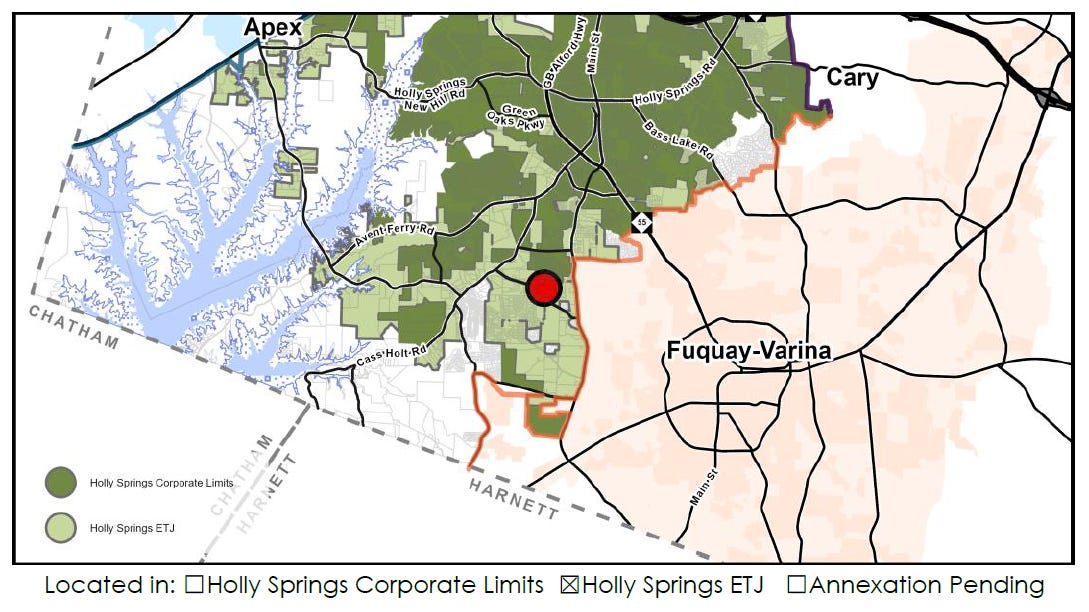
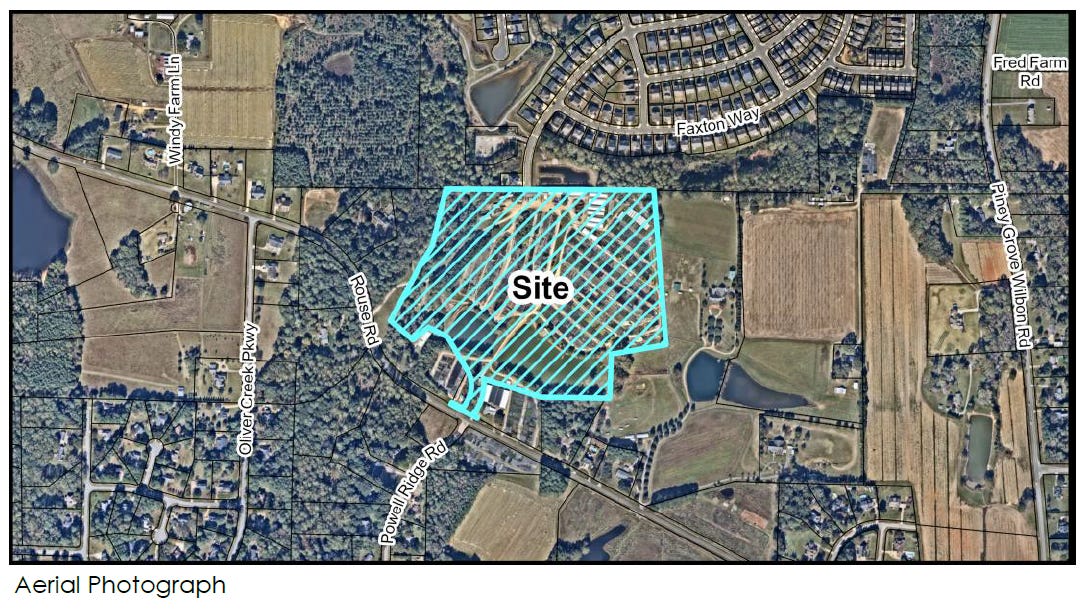
The night’s most extensive debate came during discussion of Powell Place, a proposed 32.7-acre development at 7051 and 7121 Rouse Road that would include 97 homes consisting of attached townhomes, rear-loaded detached homes and traditional front-loaded detached homes.
Town staff and the applicant repeatedly emphasized that the project had undergone significant revisions since its original public hearing in January, largely in response to traffic concerns raised by residents and council members.
Those changes included approximately 880 feet of road widening along Rouse Road, dedicated left- and right-turn lanes into the development, a proposed reduction in the speed limit to 35 mph pending NCDOT approval, and a $100,000 contribution toward a future traffic signal at Rouse Road and Piney Grove Wilbon Road.
Applicant attorney Jason Barron said the six-month gap between the January public hearing and Tuesday night’s council discussion reflected extensive coordination with staff and efforts to respond directly to council feedback.
“We heard you loud and clear,” Barron said regarding traffic concerns. “Traffic is always a concern in this area.”
Barron argued the development would provide housing diversity and relatively more attainable price points than much of Holly Springs’ recent housing stock. According to the developer, townhomes would likely start in the mid-$300,000 range and detached homes would begin in the mid-$400,000 range.
He also defended the project’s traffic commitments, saying the development itself would account for only a small share of traffic at the nearby Piney Grove Wilbon Road intersection while still contributing significant roadway improvements and signal funding.
“We think it is a substantial commitment towards helping the town alleviate issues that exist as of today,” Barron said.
Still, several council members remained uneasy about the broader transportation conditions surrounding the project, particularly the narrow sections and curves along Rouse Road and increasing traffic pressure throughout the Piney Grove Wilbon corridor.
Council Member Chris Deshazor said he appreciated the applicant’s efforts to respond to council concerns but remained uncomfortable with the roadway conditions and the project’s single entrance point.
“My major concern is that Rouse Road is a two-lane road that has no shoulders,” Deshazor said. “It is a very tight road.”
Deshazor also referenced safety concerns tied to the nearby S-curve along Rouse Road and questioned whether emergency vehicles could effectively navigate the corridor as development continues increasing in the area.
Council Member Sarah Larson echoed concerns about the corridor’s overall transportation limitations, particularly without an immediate traffic signal at Piney Grove Wilbon Road.
“It just seems like there’s not a good option to be able to reduce traffic,” Larson said.
Mayor Mike Kondratick acknowledged broader frustration surrounding traffic and growth concerns while also arguing that the project had substantially addressed the specific requests council made earlier this year.
“I think for the size, this is more than paying for their fair share of that,” Kondratick said regarding the roadway and signal commitments.
After an initial motion to approve the rezoning failed, council voted to defer the case until its July 21st meeting so additional discussion could occur around the broader corridor and transportation questions.
The debate also repeatedly referenced a planned June 1st community conversation focused specifically on the Piney Grove Wilbon corridor. Town officials said representatives from NCDOT and CAMPO are expected to participate alongside council and staff.
Annexations and zoning amendments move forward
Earlier in the meeting, council unanimously approved annexation of approximately 53.8 acres at 6200 Windy Farm Lane associated with the Evanston subdivision project. Staff said the annexation had been delayed previously to allow completion of the property purchase by M/I Homes.
Council also conducted a public hearing on the town’s semiannual Unified Development Ordinance amendments, which include changes involving special use permits, neighborhood mixed-use standards, bars, fueling stations, EV parking standards for schools and additional drive-through standards.
Senior Planner Cheryl Caines said one of the most significant changes would move several uses currently handled through special use permits into the conditional zoning process instead, allowing greater public engagement earlier in the review process.
“With the conditional district rezoning, they’re able to just come with concerns and talk about those with the town council,” Caines said while explaining the proposed process changes.
The amendment package now advances to Planning Board before returning to council for final consideration.
Council also voted to table the Twin Springs annexation request tied to property near Duncan Cook Road because of coordination and timing issues involving Fuquay-Varina’s related review process.