
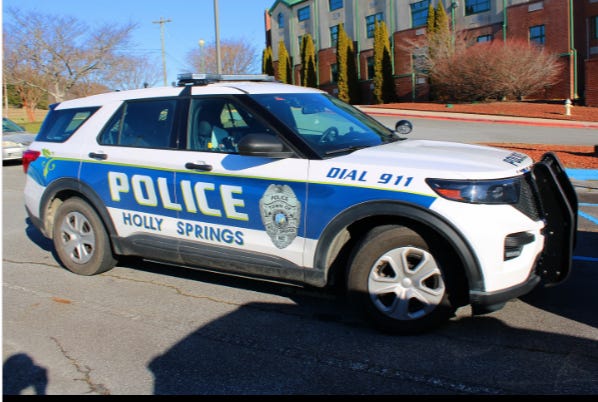
Holly Springs, NC, July 26, 2026 — Automated license plate readers have become a routine investigative tool for Holly Springs police, but last Tuesday’s town council discussion revealed the town doesn’t control every camera operating within its borders.
During a presentation requested by Town Manager Randy Harrington, Police Chief Paul Liquorie explained how the department uses automated license plate readers, commonly known as ALPRs, the safeguards that govern access to the data, and where the town’s authority over the technology ends. The council took no action other than receiving the briefing.
Liquorie described ALPRs as high-speed cameras that use optical character recognition to capture license plate numbers, along with the time and location where a vehicle was observed. That information is stored in a searchable database. He also distinguished the technology from Flock Safety, whose name has become closely associated with license plate readers nationwide. Holly Springs instead contracts with Vigilant Solutions, a Motorola subsidiary, a decision Liquorie said the department made deliberately.
The department uses the system in two ways. Officers and dispatchers receive real-time alerts when a vehicle associated with a stolen vehicle report, wanted person, or an AMBER or Silver Alert passes one of the cameras. Detectives can also search historical records during an active investigation, but only after entering a valid case number.
To illustrate its value, Liquorie highlighted several recent cases. Officers recovered a stolen vehicle that led to an arrest involving drugs, an illegal firearm, and stolen credit cards. He also described missing person investigations involving elderly residents and people experiencing mental health crises, along with a Bass Lake vehicle break-in solved after another agency queried the shared ALPR network using a captured license plate.
Liquorie stressed that the system is not an unrestricted database. Alerts provide only a license plate number, camera location and visible vehicle characteristics, such as the make, model or distinguishing damage. They do not identify the registered owner, display a driver’s license photograph or provide other personal information.
Access is also tightly controlled. Every database search requires a case number tied to an active investigation, and every query creates an audit trail identifying the officer who conducted it. State law requires ALPR records to be deleted after 90 days, and Liquorie said misuse of the system can result in disciplinary action, including termination, as well as criminal prosecution.
The town attorney addressed several legal questions raised by council members. ALPR records are classified as law enforcement criminal intelligence information and are not subject to North Carolina public records laws, the attorney said. The attorney also emphasized that simply seeing a vehicle at a particular location does not establish probable cause or reasonable suspicion for a traffic stop. Officers must have an independent legal basis before taking enforcement action.
The evening’s most significant exchange came when council members turned from how Holly Springs uses the technology to who else can.
Liquorie confirmed that local, county, state and federal law enforcement agencies may access Holly Springs’ ALPR data through memoranda of understanding. Those same agencies may also install their own license plate reader cameras inside Holly Springs, including on state-maintained roads, without obtaining approval from the town.
One council member asked whether a state agency could place a camera on a state road running through Holly Springs “without our approval or without us even knowing that they’ve put the camera there.”
“Absolutely,” Liquorie replied. “That’s right.”
Liquorie also confirmed the department maintains separate memoranda of understanding with federal law enforcement agencies for data sharing. He said he could not immediately say whether those agreements include expiration dates and would follow up with the council.
That discussion reflects a broader legal debate that remains unresolved. Courts have generally concluded that a single ALPR scan is no different than an officer observing a license plate in plain view on a public roadway and therefore does not constitute a Fourth Amendment search. Less settled is whether searching months of historical ALPR data raises different constitutional questions because it can reveal patterns of a person’s movements.
The issue traces in part to the U.S. Supreme Court’s 2018 decision in Carpenter v. United States, which held that historical cell phone location records are protected by the Fourth Amendment because they can paint a detailed picture of a person’s daily life. Courts have generally distinguished ALPR data from cell phone tracking, but judges, including members of the U.S. Court of Appeals for the Fourth Circuit, which includes North Carolina, have suggested that prolonged or aggregated surveillance could eventually receive similar constitutional scrutiny. Congress has not enacted nationwide standards governing ALPR use.
Liquorie closed the presentation by noting that Holly Springs leases its cameras and subscribes to the supporting database rather than purchasing the equipment outright. That arrangement, he said, allows the town to change vendors if it becomes dissatisfied with Vigilant’s policies or data practices.
For Holly Springs, the town controls the cameras it owns and the policies governing their use. Monday night’s discussion made clear that it does not control every license plate reader operating within its borders, a distinction rooted not in local policy but in the separate legal authority granted to other law enforcement agencies.