
Holly Springs, NC, Jun. 9, 2026 — A series of development ordinance changes approved by the Holly Springs Town Council on June 2nd may not dramatically alter what gets built in town, but they could change when and how residents participate in those decisions. Through a package of 20 Unified Development Ordinance (UDO) amendments, council members approved changes that move several types of development proposals into a review process that allows public concerns to be raised earlier and considered more broadly before final decisions are made.
What is a UDO?
The Unified Development Ordinance, commonly called the UDO, is Holly Springs’ primary development rulebook. It governs how land can be used and developed throughout town, including zoning, permitted uses, building design, parking, landscaping, open space, transportation connections, and many of the standards that shape future neighborhoods and commercial areas.
Link: Holly Springs Unified Development Ordinance
The most significant change involves moving several land uses from the town’s Special Use Permit process to the Conditional District rezoning process. Staff said the adjustment affects uses that can have substantial impacts on surrounding neighborhoods, including community support facilities, residential care facilities, and data centers. Under the existing process, public hearings occur near the end of project review, and concerns generally must be supported by evidence. The Conditional District process places the public hearing at the beginning, adds Planning Board review, and provides multiple opportunities for residents to weigh in before a proposal returns to council for a final decision.
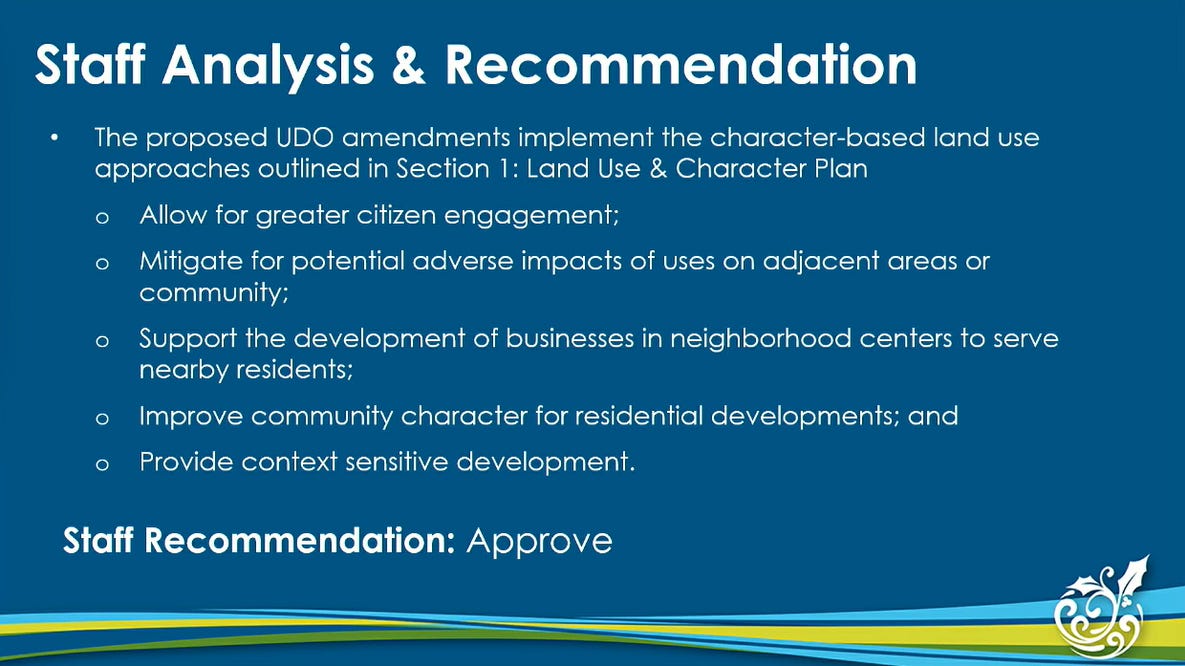
Senior Planner Cheryl Caines said the change is intended to strengthen public participation while allowing the town to consider broader impacts that extend beyond an individual property. Explaining the difference between the two review processes, she noted that under the Conditional District process, “the feedback that is provided can just be concerns, it doesn’t have to be supported by evidence.” Staff also emphasized that the revised process allows the council to evaluate broader issues, such as infrastructure capacity and community-wide impacts, as projects move through the review process.
One of the most notable amendments involves data centers, a topic that has generated increasing public interest across Wake County and beyond. Data centers are currently permitted in Business Research and Technology districts, but the new rules require such projects to undergo Conditional District rezoning review. That change means future proposals would receive additional public scrutiny and multiple opportunities for citizen input before the council makes a decision.
While council members generally supported expanding public participation, the discussion centered on whether the more extensive rezoning process could impose unintended burdens on nonprofit organizations. Mayor Mike Kondratick said he supports giving neighbors opportunities to comment on facilities that may affect residential areas, but expressed concern that additional application costs could pose obstacles for smaller nonprofits. “I have concerns that we’re kind of building some barriers that might make it difficult to bring, you know, to start a new non-profit in our community,” he said.
Other council members generally supported the change while acknowledging those concerns. Council Member Chris Deshazor argued that the Conditional District process provides needed structure around uses that can significantly affect nearby neighborhoods. “This gives us some structure around what can go in and near a neighborhood,” he said during the discussion. Deshazor also pushed back against the assumption that all nonprofit organizations operate with limited resources, noting that some have substantial financial capacity.
Council Member Kara Foster raised similar concerns about smaller nonprofits and small businesses, suggesting the town may want to revisit the issue in a future amendment cycle to explore accommodations or exemptions for organizations with limited resources. Although no changes were made to the amendment package, several members indicated they would be open to refining the process in the future if concerns emerge.
The amendments also include a range of development standards that received less discussion but will shape future projects throughout the town. New rules require rear-loaded lots to front on active open space rather than passive preservation areas, establish architectural standards for retaining walls, and create additional design requirements for drive-through facilities and car washes. The intent, staff said, is to create more pedestrian-friendly development patterns and improve the appearance of future projects.
Additional changes expand opportunities for neighborhood-serving businesses. Standalone bars will be allowed in Neighborhood Mixed-Use districts under size and location restrictions, while fueling stations may be permitted under standards intended to prevent them from dominating major intersections. Staff said the goal is to provide services closer to residential neighborhoods while maintaining compatibility with surrounding development.
Council also approved modifications to electric-vehicle parking requirements for schools after staff determined that the standards adopted in 2022 did not align well with school operations. The revised requirements reduce the number of EV charging spaces that must be installed initially while requiring additional spaces to be EV-ready for future expansion. Staff said the changes provide flexibility as electric vehicle adoption continues to evolve while reducing upfront construction costs.
The Planning Board unanimously recommended approval of the amendments, and no residents spoke during the public hearing held in May. Council ultimately approved the package unanimously, concluding a discussion that was less about specific development projects and more about how future projects will be reviewed. As Holly Springs continues to grow, the most significant impact of the amendments may be the expanded opportunity for residents to participate earlier in conversations about the developments that shape their community.