

A 152-home residential development planned on just over 53 acres off Windy Farm Lane is moving forward after the Holly Springs Town Council approved the Evanston major subdivision (25-MAS-03) during its March 17th meeting.
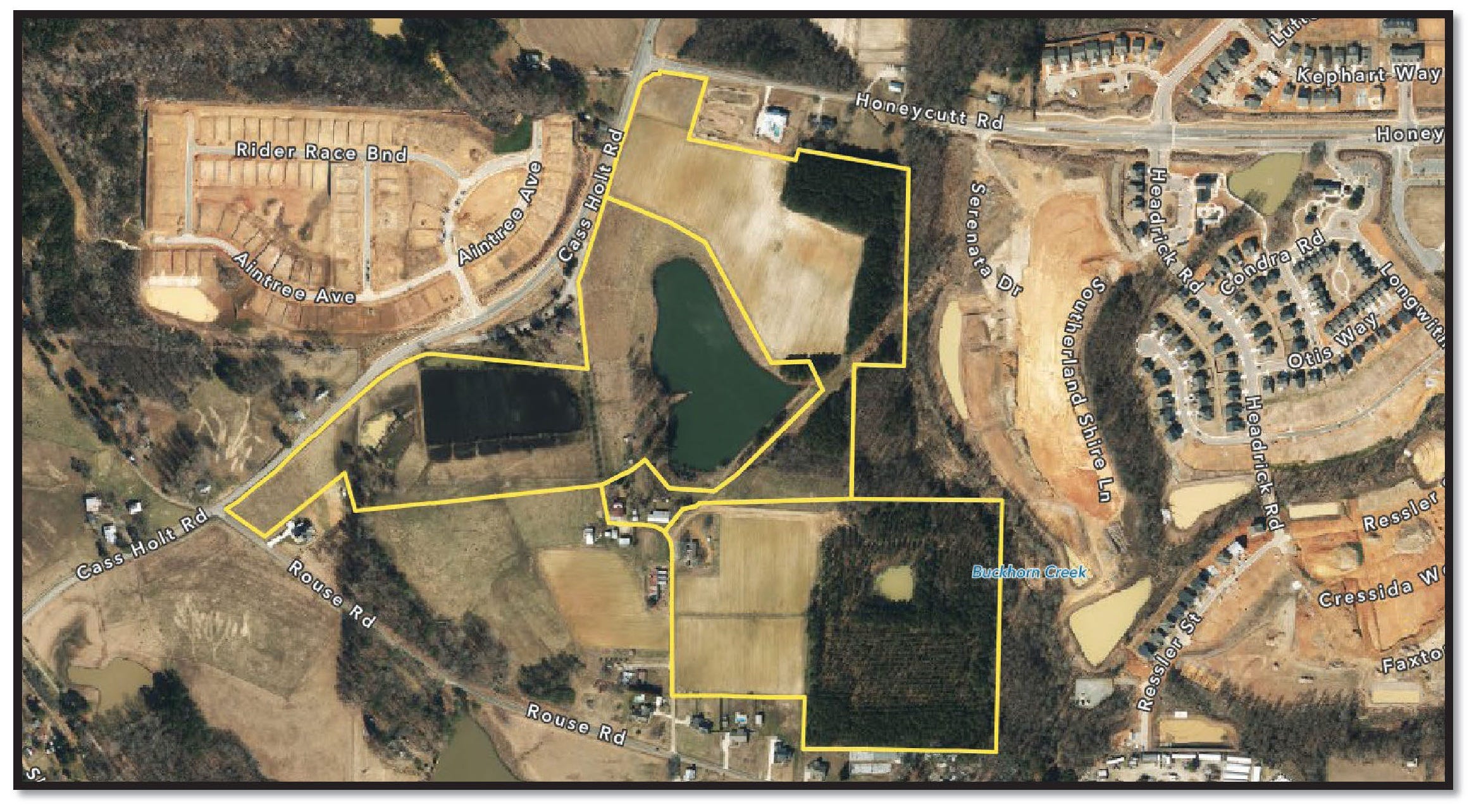
The quasi-judicial vote clears the next step for the Evanston subdivision at 6200, 6202, and 6213 Windy Farm Lane, in an area between Cass Holt Road, Honeycutt Road, and Rouse Road that continues to transition from rural land to new residential neighborhoods. During the meeting, town staff described the site as “somewhat sandwiched between Honeycutt Road and Rouse Road at the corner of Cass Holt,” which helps frame its position within one of the town’s fastest-growing corridors.
What the Plan Includes
The development will include 152 homes, a mix of attached and detached housing. That total was established during the earlier rezoning process, and staff emphasized during the meeting that the subdivision plan remains consistent with those previously approved limits.
“A maximum of 152 dwelling units were permitted, or 2.3 units per acre,” staff told council, noting that the current layout aligns with those standards.
The plan places higher-density attached homes closer to Cass Holt Road, while lower-density detached homes are situated deeper within the site, creating a transition in scale across the neighborhood and aligning with the town’s land-use framework for the area.
Traffic Study and Road Improvements
Much of the infrastructure tied to the project was determined before this vote, particularly regarding traffic. A full Traffic Impact Analysis was completed during the rezoning stage, along with a Transportation Mitigation Agreement outlining required improvements. At this stage, the town reviewed a traffic verification memo to confirm that the subdivision plan remains consistent with that earlier analysis.
“The traffic study, traffic impact analysis, and transportation mitigation agreement were completed with the rezoning petition,” staff said. “A traffic verification memo was provided with the major subdivision plans to confirm consistency with the TIA.”
Those earlier findings now translate into required roadway changes tied directly to the development. Improvements along Cass Holt Road, Honeycutt Road, and Rouse Road include added turn lanes, access controls, and signal-related upgrades designed to manage increased traffic from the new neighborhood. Staff noted that portions of Cass Holt and Honeycutt Roads will be widened along the site frontage to meet long-term transportation plans, ensuring the surrounding network can support future growth.
An internal collector street will also connect Cass Holt Road to Rouse Road, allowing traffic to move through the development more efficiently and reducing reliance on a single point of access.
Amenities and Environmental Features
Beyond transportation, the plan incorporates a range of neighborhood features and environmental considerations that shape how the development will function day to day.
The subdivision includes seven active recreation areas distributed throughout the site, along with preserved tree areas near Buckhorn Creek. Staff explained that these natural areas are being integrated into the overall design, both to maintain existing environmental features and to provide usable open space for residents.
A greenway connection to Honeycutt Farm is also planned, along with additional stubs that could link to future greenway extensions. These connections are intended to tie the neighborhood into the town’s broader trail network over time. Public art within a roundabout is also included, reflecting conditions established during the rezoning approval.
Sponsored Advertising

Click on the image for more information
Schools and Growth Impacts
The review process also highlighted expected impacts on local schools, an issue that continues to surface as residential growth accelerates across Holly Springs.
Wake County Public Schools indicated that elementary school capacity in the area is projected to be insufficient, meaning some future students from the development may be assigned outside their base schools. That concern reflects broader pressures across the region, particularly in areas where multiple developments are underway simultaneously.
Why Council Approved It
Because the request was considered under quasi-judicial standards, the council’s role was limited to determining whether the application met the town’s adopted requirements and prior zoning conditions.
Staff concluded that the plan was consistent with the comprehensive plan, transportation and greenway plans, and subdivision regulations. Under those standards, approval is required when the criteria are met, and the council ultimately voted to allow the subdivision to proceed.
A Growing Area Takes Shape
The approval of Evanston adds another piece to the continued buildout of the Honeycutt–Cass Holt–Rouse Road area, where farmland and large tracts are steadily being converted into connected residential neighborhoods.
For residents, that means not only more housing but also ongoing changes in traffic patterns, expanded greenway access, and increased demand on public infrastructure and services as the area evolves.
What’s Next
With subdivision approval complete, the project will move into final engineering and construction permitting. Infrastructure work, including road improvements and utility installation, will be coordinated as part of that process. A construction timeline was not specified during the meeting.