

Holly Springs, NC, Feb. 8, 2026 — Electric and motor-assisted two-wheeled vehicles are becoming a common sight across Holly Springs and South Wake County, on neighborhood streets, near schools, and on greenways. For many families, they look like a convenient, modern step between bicycles and cars.
But under North Carolina law, vehicles that may look similar can fall into very different legal categories, each with its own rules around age, licensing, insurance, and where they may be used.
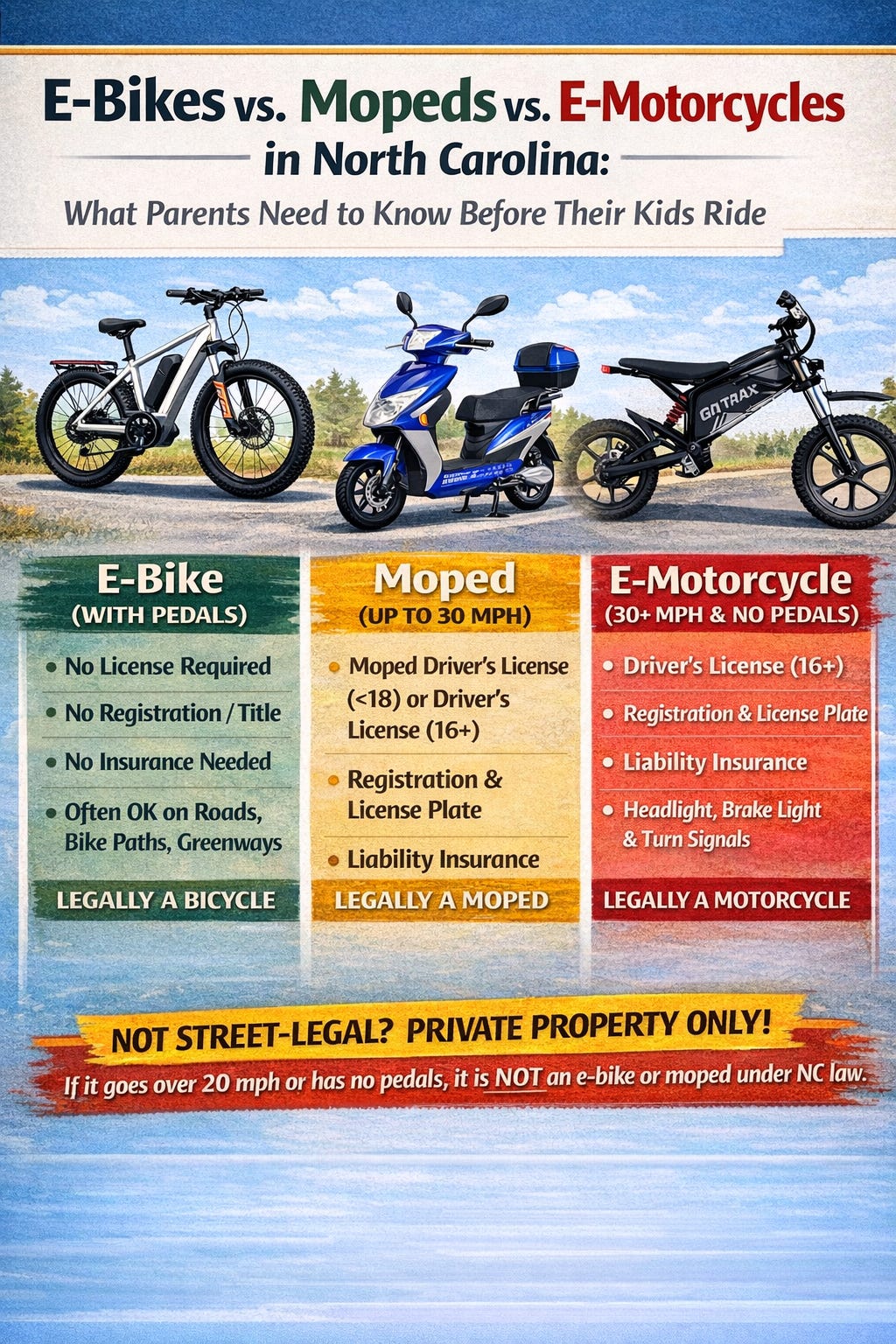
The confusion often starts with a simple assumption: if it’s small and electric, it must be treated like a bike. In reality, North Carolina recognizes three distinct categories that parents should understand: e-bikes, mopeds, and e-motorcycles.
What North Carolina Considers an E-Bike
North Carolina law defines an electric bicycle very narrowly. To qualify, a vehicle must have usable pedals, a motor no larger than 750 watts, and a motor-only top speed that does not exceed 20 miles per hour on level ground.
When, and only when, those conditions are met, the vehicle is legally treated as a bicycle, not a motor vehicle. That distinction matters because bicycles are not subject to state licensing, registration, title, or insurance requirements.
As with conventional bicycles, e-bikes permitted on sidewalks or greenways must be operated courteously. State and local rules require riders, including those on traditional bikes, e-bikes, and other permitted electric conveyances such as e-scooters, to yield the right-of-way to pedestrians and ride in a manner that does not endanger pedestrians.
From a practical standpoint, e-bikes can often be used on greenways, bike lanes, and neighborhood streets unless a local ordinance states otherwise; in shared spaces, pedestrians always come first.
Where Mopeds Fit In, and Why They’re Different
Mopeds occupy a middle ground that many parents don’t realize still exists in North Carolina law.
A moped is a motor-driven vehicle designed to travel at 30 miles per hour or less and typically lacks pedals. Mopeds may be gas-powered or electric. While they are slower and smaller than motorcycles, they are still classified as motor vehicles, not bicycles.
Because of that classification, mopeds are subject to legal requirements that e-bikes are not. Mopeds must be registered with the state, carry liability insurance, and display a license plate. However, a full motorcycle endorsement is not required to operate one.
North Carolina law allows licensed drivers and, in some cases, younger riders with limited permits to operate mopeds, though local rules and parental responsibility play a significant role. Importantly for parents, mopeds are not allowed on greenways, sidewalks, or bike paths, even though they may appear similar in size to e-bikes.
Mopeds are allowed on public roads, but only where posted speed limits and roadway conditions make their use practical and legal.
When an Electric “Bike” Becomes an E-Motorcycle
Many electric vehicles marketed online as “e-bikes” do not meet North Carolina’s legal definition of an e-bike, and they often don’t qualify as mopeds either.
If an electric vehicle can exceed 20 miles per hour under motor power, has a motor larger than 750 watts, or lacks usable pedals, it is no longer an e-bike. If it also exceeds moped speed limits or design standards, it is classified as a motorcycle, even if it appears small or is marketed to teens.
At that point, the vehicle is fully regulated as a motor vehicle under state law.
What the Law Requires for E-Motorcycles
E-motorcycles are subject to the same core requirements as gas-powered motorcycles. To be operated on public roads, they must be titled and registered, display a license plate, and carry liability insurance. They must also be equipped with the required safety features, including headlights, brake lights, taillights, turn signals, mirrors, and a horn.
Just as important, the rider must be properly licensed. In practice, this means being at least 16 years old and holding a driver’s license with a motorcycle endorsement or permit. Without all of these elements in place, an e-motorcycle is not street-legal in North Carolina.
Where Each Type of Vehicle Can, and Cannot, Be Used
Location is where these distinctions matter most for families.
True e-bikes may generally be used on public streets, bike lanes, and greenways unless a local ordinance restricts them. Mopeds and e-motorcycles, even when street-legal, are limited to roadways and are not allowed on greenways, sidewalks, or bike paths.
If a moped or e-motorcycle is not properly registered, insured, or equipped, its use is effectively limited to private property only, and only with the property owner’s permission. Neighborhood streets that are publicly maintained still count as public roads under the law.
This is where many families run into trouble, especially when riding “just around the neighborhood.”
A Common Assumption, and Why It’s Risky
Parents often assume that if a vehicle is electric and sold alongside bikes, it must be treated like a bicycle. Under North Carolina law, speed capability, motor power, and design, not marketing, determine legality. A child riding a vehicle that legally qualifies as a moped or motorcycle in a space reserved for bicycles can face enforcement issues, and families may face insurance and liability complications if an accident occurs.
Why This Matters for Families
Beyond citations or fines, misclassification can affect insurance coverage and parental liability. If a child is injured or injures someone else while operating a vehicle that should not be on public property, families may encounter consequences they did not anticipate. Understanding these categories before buying or allowing use can help parents make informed decisions and reduce risk.
Editor’s note: This story is intended to explain how North Carolina law currently classifies electric and motor-assisted two-wheeled vehicles. Parents are encouraged to verify a vehicle’s top speed, motor power, and design, and to check local ordinances and insurance requirements, before allowing children to ride outside private property.