
Holly Springs, NC, Jan. 12, 2026 — President Donald Trump recently said White people were “very badly treated” after the Civil Rights Act, arguing that qualified White applicants were denied college admission and jobs as a result of “reverse discrimination.”
While individual disputes and lawsuits over race-conscious policies have existed, there is no evidence that the Civil Rights Act or its enforcement resulted in widespread or systemic mistreatment of White Americans. Long-run data on income, education, and homeownership point in the opposite direction.
Why this conclusion matters: The verdict turns on long-run outcomes, not individual anecdotes. The sections below explain why this claim persists, how civil rights law actually works, and what the data show over time.
What the Civil Rights Act did, and did not do
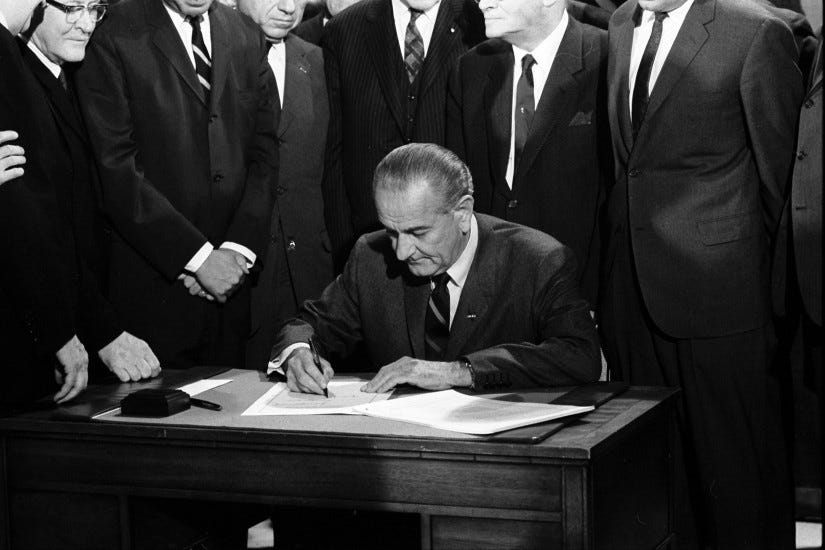
The Civil Rights Act of 1964 outlawed race-based discrimination and segregation in employment, education, housing, and public accommodations. Its central purpose was to end exclusion, not to impose quotas or require institutions to disadvantage White Americans.
Subsequent court rulings clarified how the law could be applied:
Explicit racial quotas were prohibited
Race could not be the sole deciding factor in admissions or hiring
Any race-conscious policies had to be limited and narrowly tailored
Those guardrails matter because the claim treats the Civil Rights Act itself as the source of harm, a framing not supported by the law’s text or its judicial interpretation.
What the long-run outcomes show
Household income
Across the post–civil rights era, White households have consistently reported the highest average household income among major racial and ethnic groups. While gaps narrowed modestly in percentage terms, the absolute dollar gap widened, meaning White households continued to pull ahead in real terms.
A system that broadly disadvantaged White Americans would be expected to show sustained declines in relative income. That pattern does not appear in Census data.
Educational attainment
Educational attainment rose sharply for all groups after the 1960s, including White Americans. The share of White adults with a bachelor’s degree or higher increased substantially, and remained well above that of Black and Hispanic adults throughout the period.
This directly undercuts the notion that civil rights laws led to the large-scale exclusion of qualified White students from higher education.
Homeownership
Homeownership is one of the clearest long-term measures of economic opportunity. White households have maintained significantly higher homeownership rates than Black or Hispanic households for decades, with the gap changing little since the 1960s.
If civil rights enforcement had produced systemic displacement, that pattern would likely look very different.
Why this claim persists, and where people talk past each other
Much of the confusion around “reverse discrimination” stems from conflating the law, later policy choices, and modern political fights.
The Civil Rights Act prohibited discrimination. Many of the policies now cited as evidence of “anti-White bias”, including affirmative action frameworks and corporate DEI programs, emerged years or decades later, often voluntarily and under evolving court guidance. Treating those policies as synonymous with the 1964 law blurs important legal and historical distinctions.
There have also been individual disputes and lawsuits in which White applicants alleged discrimination. Courts have repeatedly affirmed that civil rights protections apply to all individuals, regardless of race. But individual cases do not establish system-wide outcomes. Public policy claims are evaluated by aggregate patterns, not anecdotes.
Recent legal developments have lowered procedural barriers to so-called “majority-group” discrimination claims, making such cases easier to hear. That change expands access to legal remedies; it does not demonstrate that civil rights laws caused widespread harm.
As legal scholars often note, when a system moves from exclusion to equal access, those accustomed to historic advantage may experience that shift as a loss, even when population-level outcomes remain favorable.
The Bottom line
Did the Civil Rights Act end race-based exclusion? Yes
Did it impose systemic discrimination against White Americans? No. Long-run data on income, education, and homeownership do not support that claim
Do later disputes over DEI or affirmative action change that conclusion? No. They are legally and historically distinct from the 1964 law
At most, the claim reflects individual grievances and political rhetoric, not a data-supported account of how White Americans fared after civil rights protections took effect.
Author’s note
This fact check evaluates claims about discrimination using population-level data, not individual anecdotes. Individual hiring or admissions disputes, including lawsuits, can and do occur in any large system, and civil rights laws provide legal remedies for those cases. But claims that a law or policy produced systemic harm must be assessed by long-run trends in income, education, housing, and other broad outcomes. That is the standard used by economists, courts, and policymakers when evaluating the real-world impact of civil rights laws, and it is the standard applied here.
About the Author
Christian A. Hendricks is the publisher and founder of Holly Springs Update, a local news publication covering Holly Springs, NC, and its surrounding area. From time to time, he shares his views on national, regional, and state issues. He can be reached via email at christian.hendricks@hollyspringsupdate.com.