
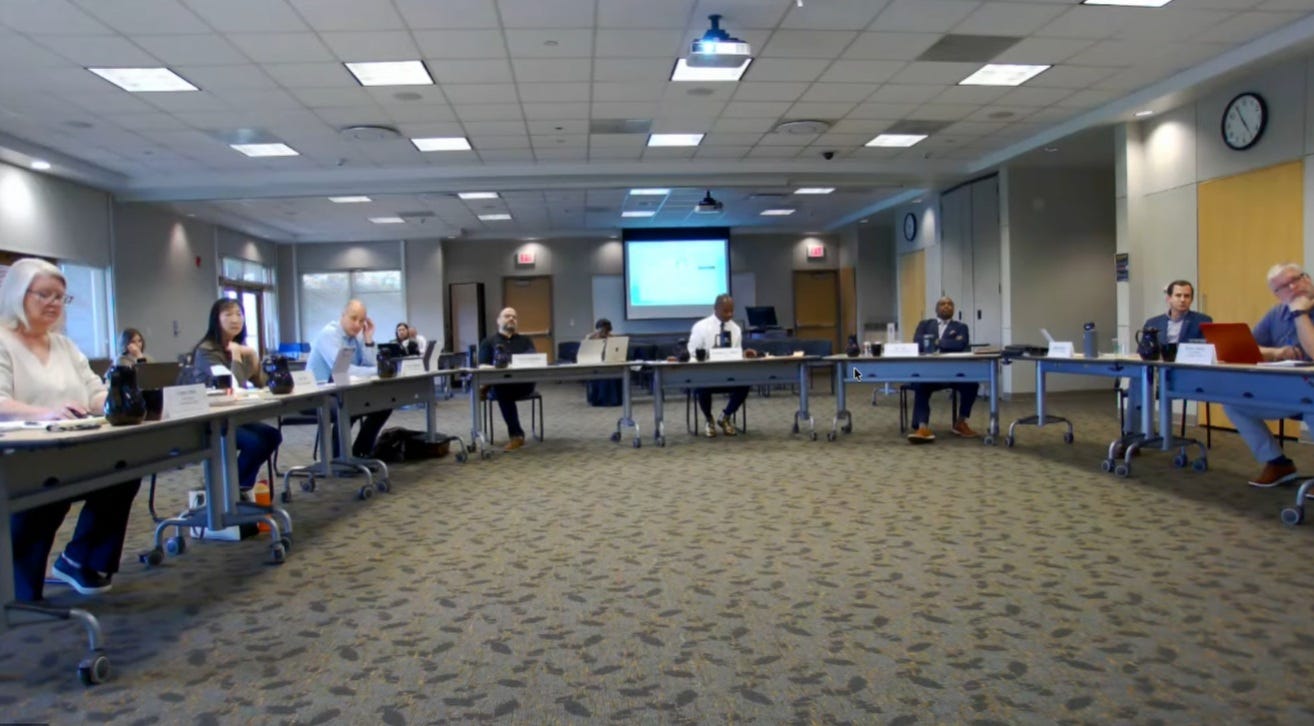
Apex, NC, April 21, 2026 — Tonight’s Apex Town Council’s Work Session wasn’t about a rezoning or budget vote. It was about the machinery behind those decisions, how the council organizes itself, how residents are appointed to advisory boards, how elected officials communicate, and how the town manages expenses, events, and public input.
Held at Town Hall, the session covered council committees, advisory boards, financial policies, social media practices, town-sponsored events, and public comment rules.
Town Clerk Allen Coleman framed the discussion through research across 21 North Carolina municipalities, emphasizing that staff were presenting data, not recommendations.
“We don’t really have a proposal… This is really what you all feel like you want to do,” Coleman said.
Committees: Streamlining Work or Shifting Power?
The longest discussion focused on council committees, how they function, and the influence they wield.
Coleman said just over half of the surveyed municipalities use formal committees, with wide variation in structure and mayoral involvement. Apex currently uses two-member committees, quarterly meetings, and no livestreaming, a structure adopted in 2025 and implemented in 2026.
Mayor Jacques Gilbert defended the committee's involvement, including his own participation, and presented an updated assignment structure that largely maintains continuity, especially in areas like environmental leadership, where ongoing issues, such as data center discussions, remain active. He also noted that another council member had expressed that a person should be placed on a committee based on financial skillset and experience, reflecting how peer input shaped assignments.
But the core debate wasn’t who serves. It was what committees do.
“A committee can’t kill an idea, only council. A committee can’t approve an idea, only council,” one member said.
That view framed committees as working groups designed to refine, vet, and narrow options before returning them to the full council.
Tension emerged around whether committee chairs could control what moves forward. Some members supported mayoral participation but drew a line at leadership roles that could influence legislative flow.
“I have no problem participating… but not as a chair or vice-chair,” one member said.
Council ultimately signaled support for keeping committees, maintaining two-member structures due to quorum limits, and reinforcing their role as issue-refining, not decision-making, bodies, with the mayor proposing assignments and council confirming them.
Advisory Boards: More Structure, More Scrutiny
As resident participation grows, so does pressure on how advisory board seats are filled.
Apex currently uses a mayor-recommends, council-appoints model. Coleman said that approach is common, though not universal.
The sharper debate centered on interviews.
Most municipalities don’t conduct them, Coleman said, but some use them for statutory boards or when candidates are tied. That became relevant to Apex’s recent Planning Board process.
Some council members supported interviews, especially for boards requiring public decision-making, arguing that applications alone don’t reveal how candidates perform.
Others warned about overcomplicating a volunteer process.
“I don’t want people to feel like pawns,” one member said.
Council also moved toward a clearer voting structure. Members can vote yes or no on each candidate rather than being limited to one choice per seat. Interviews could then be triggered if no candidate receives a majority or a tie remains.
The direction taking shape includes keeping the mayor-recommends, council-appoints model, using interviews for statutory boards, and using interviews elsewhere only for ties or no-majority outcomes.
Stipends and Spending: Policy Meets Reality
Financial policy for elected officials exposed a gap between guidelines and real-world costs.
Coleman outlined best practices, including limiting the use of individual credit cards, defining reimbursement boundaries, and requiring documentation. A proposed four-county boundary, Wake, Durham, Johnston, and Chatham, would treat most local travel as covered by stipends.
Mayor Gilbert addressed one of the more sensitive topics directly.
“When I took office… I was told, ‘you get a P card.’ I didn’t ask for one,” he said. “I don’t have a problem with giving up my P card.”
Council responses leaned toward eliminating individual cards in favor of reimbursement. But the bigger issue was whether the stipends themselves are set correctly.
Members noted that the mayor, mayor pro tem, and council members face different workloads and expenses, particularly related to events and travel. Rather than tightening rules alone, the council asked staff to review whether stipend levels reflect actual costs.
Social Media: Personal Voice vs. Official Position
As council members increasingly communicate directly with residents online, Apex is trying to define where personal opinion ends and official messaging begins.
Coleman said social media policies for elected officials are uncommon, but archiving is not.
Council members raised concerns about confusion and liability if official and personal messaging blur.
“If you start blurring those lines… it creates confusion… and potentially creates a liability,” one member said.
Legal guidance made clear the town cannot tightly control elected officials’ speech due to First Amendment protections.
“If you want the official… position… you need to be reaching out to the town,” the staff said.
The emerging direction includes encouraging disclaimers that distinguish personal views, archiving elected officials’ activity, avoiding the use of town logos on personal accounts, and directing constituent requests through official channels.
Town Events: Engagement vs. Campaign Boundaries
Council also addressed how town resources support events hosted by elected officials, including town halls and office hours.
Coleman emphasized a firm legal boundary.
“We cannot use public funds on campaign events…”
Council supported access to town facilities for official events, the promotion of events open to the public, and limited financial support, typically in the form of stipends, subject to approval.
The goal is to support engagement without crossing into campaign activity.
Public Comment: Managing Demand Fairly
The session closed with a practical issue: how to handle public comment when turnout exceeds limits.
Apex currently caps public forums at 12 speakers or 36 minutes and requires in-person participation.
Rather than cutting off speakers, the council discussed adjusting the time before comments begin when turnout is high, shortening each speaker’s time so more residents can be heard.
“So from an equitable standpoint, you’re doing that on the onset,” Coleman said.
One Item Deferred
Naming practices requested by elected officials were listed on the agenda but not discussed and will return at a future work session.
What Comes Next
Staff will convert this direction into formal policy drafts for council review in June.
The discussion made clear that Apex isn’t just managing growth. It is redefining how decisions are made, who shapes them, and how residents engage with them.