
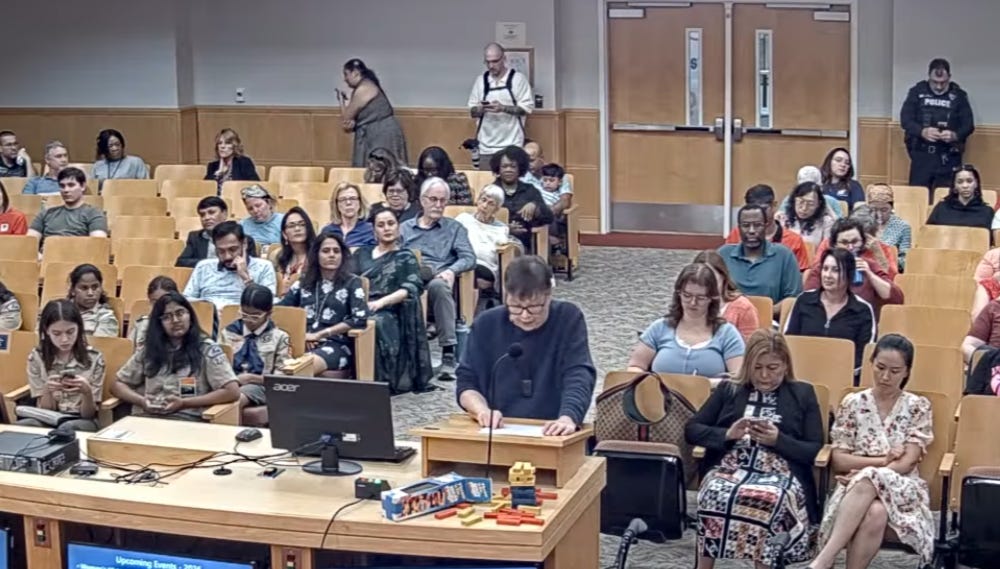
Apex, NC, Mar. 12, 2026 — Residents used the public forum portion of the March 10th Apex Town Council meeting to raise concerns about housing affordability, transparency in local government, and town service policies affecting older residents.
Several speakers focused on the growing gap between housing prices and the incomes of people who work in Apex.
One resident told the council that many workers who support the town’s economy can no longer afford to live there. According to the data he presented, an estimated 87 percent of workers in Apex commute into town from elsewhere, often because housing costs are too high.
The speaker also cited town planning documents estimating that Apex will need roughly 3,600 additional affordable homes over the next decade to meet demand from low- and moderate-income households.
“That is simply not attainable or not sustainable,” the resident said, noting that many families are paying more than 30 percent of their income on housing.
The resident proposed several potential steps the town could take to expand housing options. Those ideas included increasing funding for home repair programs that help seniors remain in their homes, purchasing land for future affordable housing development, and offering financial incentives to encourage developers to include lower-cost units in new projects.
Current funding levels, he said, may fall far short of what is needed.
“Apex’s current penny tax for the affordable housing fund raises about $2 million annually,” he said. “Doubling that could help catalyze about 1,000 units over the next decade.”
Even with that increase, he added, the town could still face a shortfall of thousands of affordable homes.
Calls for Better Access to Information
Another resident used the public forum to call for improved communication between town leaders and residents.
He noted that Apex once had a local newspaper that served as a centralized source for residents to learn about town issues.
“Back in the day, we had the Apex Herald,” the resident said. “If you wanted to know what was happening in Apex, you would just go pick up the Apex Herald.”
Today, he argued, information is scattered across multiple social media platforms, making it difficult for residents to stay informed.
“We have a community that doesn’t have equal access to information,” he said.
To address the problem, he suggested that council members list their social media accounts on their official town profile pages and that the town website include a central page linking to posts made by elected officials.
Such a system, he said, would make it easier for residents to find information about issues affecting the community.
“People need to have access to the information,” he told the council. “We do not need to put barriers up in our community.”
Concerns About Town Services
Another resident raised concerns about the physical challenges some older residents face with waste and recycling policies.
The speaker, who said she is 74 and uses a mobility aid, described the difficulty of moving large trash and recycling carts to the curb each week.
“I already have a hard time getting the trash and recycling cans to the curb,” she told the council, explaining that the containers themselves can weigh more than the waste inside them.
She urged town leaders to consider how changes to services might affect seniors and residents with disabilities who must manage the process on their own.
What’s Next
While the council typically does not take action during the public forum portion of meetings, the issues raised by residents may influence future discussions on housing policy, communication with residents, and municipal service programs.