
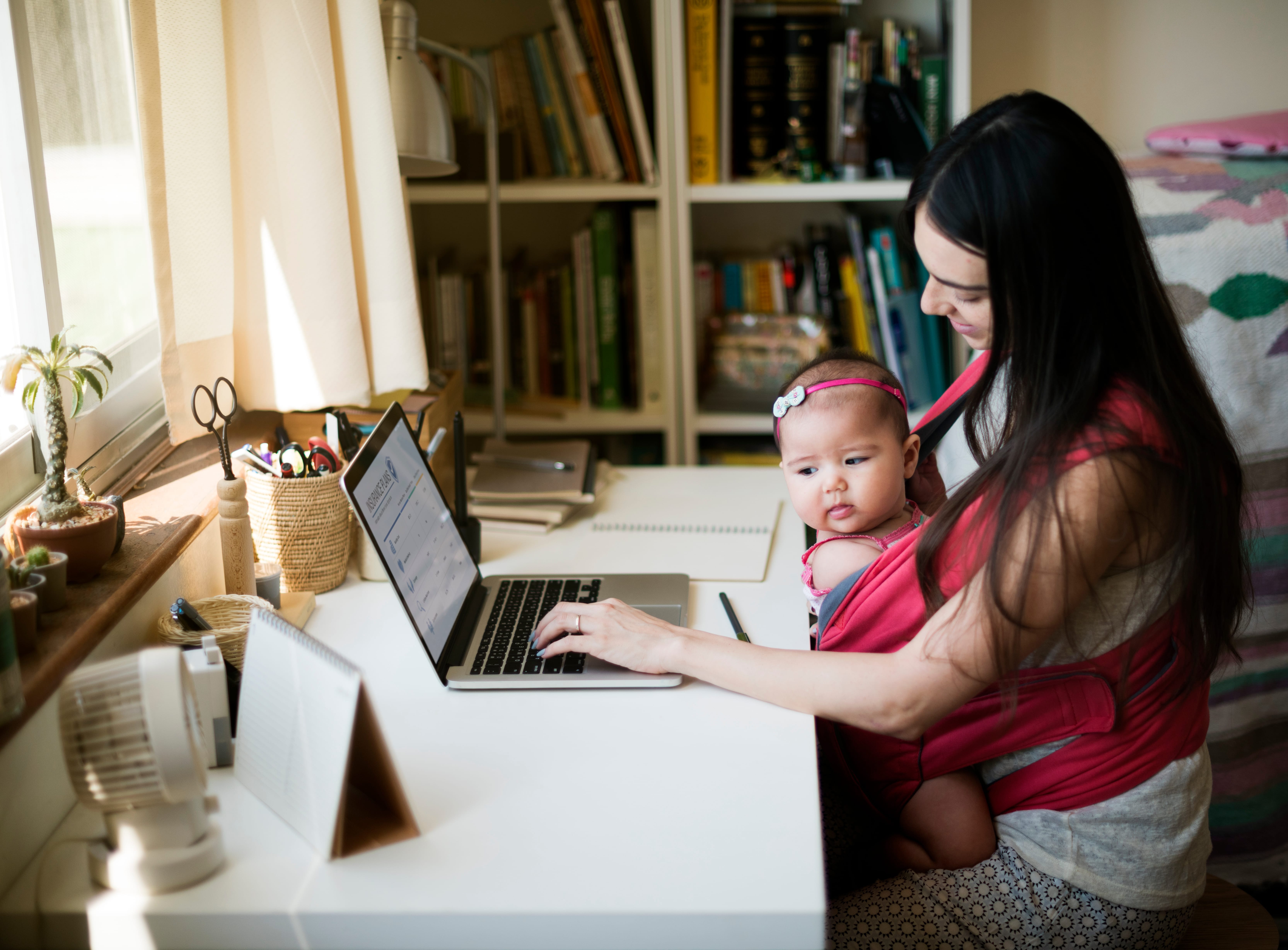
“I’m supposed to work like I don’t have kids and supposed to parent like I don’t have a job.”
Holly Springs, NC, Jun. 20, 2026 — Among the many statistics in Pew Research Center’s new study (document) of working parents, that observation from one mother may be the most revealing. It captures the reality millions of American families navigate every day: a world where work and family responsibilities increasingly overlap, but the systems surrounding them have not fully adapted.
The study’s central finding is not simply that parenting is hard. Parenting has always been hard. Rather, it is that America has normalized a family structure that many of its institutions still seem unprepared to support.
Today, 52% of households with children consist of two parents working full time. In 1975, that figure was just 31%. What was once relatively uncommon has become the dominant family arrangement.
Yet much of modern life still appears designed around assumptions from an earlier era.
Seven in 10 full-time working parents say they handle parenting-related tasks while they are working, and nearly six in 10 say they handle work-related tasks while spending time with their children. More than half say balancing work and family responsibilities is difficult.
The result is a constant balancing act. Nearly six in 10 parents say they felt unable to give 100% at home because they were juggling work and family responsibilities, while nearly half said they couldn’t give 100% at work. Many also reported missing activities their children were participating in because of work obligations.
The study also reveals that the challenges of working parenthood are not distributed evenly.
Pew classifies families as lower-, middle- and upper-income based on household earnings adjusted for family size and local cost of living rather than fixed national income thresholds. By that measure, lower-income parents face a much steeper climb.
Parents in lower-income households are substantially less likely to have access to health insurance, paid time off, paid family leave or work-from-home flexibility. Only one-third report access to paid family or medical leave, compared with 70% of upper-income parents. Just 12% say they have significant flexibility to work from home when needed, compared with 43% of upper-income parents.
Those disparities become even more consequential when something unexpected happens.
When asked what would happen if a child became sick or childcare arrangements fell through, more than half of lower-income parents said they would be highly worried about losing pay. Nearly one-third worried about losing their jobs. Among upper-income parents, those concerns were dramatically lower.
The realities of modern parenthood affect families across the economic spectrum. But the study makes clear that families with fewer resources often face the greatest consequences when work and family collide.
Mothers face a different challenge. Pew found that even in households where both parents work full time, mothers continue to shoulder a disproportionate share of day-to-day parenting responsibilities and household chores. They are also more likely than fathers to say balancing work and family responsibilities is difficult.
The result is predictable. Working mothers are more likely than fathers to report not having enough time for hobbies, friendships, exercise or even relaxation. When both work and family demand more than a person can reasonably give, something has to be sacrificed. For many parents, especially mothers, that sacrifice is personal time.
Remote work, often promoted as a solution to work-life balance challenges, offers only a partial answer. Parents who work from home are more likely to attend their children’s activities and have greater flexibility during the day. Yet they are no less likely than other parents to report difficulty balancing work and family responsibilities. The overlap between the two worlds simply becomes more visible.
The study also identifies a disconnect between what parents say they need and what many employers provide. More than eight in 10 working parents say paid parental, family or medical leave would be highly helpful, yet only half report having access to it. Most parents with young children say onsite childcare would be valuable, but only a small fraction say it exists where they work.
Taken together, the findings point to a broader reality. America has built an economy that increasingly depends on two working parents. Yet many of the institutions surrounding family life have struggled to keep pace. Workplaces often provide less flexibility and fewer family-support benefits than parents say they need. Childcare remains expensive and difficult to secure. School events, extracurricular activities and work schedules frequently compete for the same hours of the day. None of these systems were designed in isolation, but together they create a reality in which many parents feel perpetually torn between competing responsibilities.
None of this suggests that raising children has ever been easy. Nor does it suggest there is a single solution.
But the Pew study points to a larger truth: The structure of American family life has changed dramatically over the past half-century. Many of the institutions that shape daily life have changed too, but not always at the same pace.
Until they do, millions of parents will continue living in the gap between what modern family life requires and what modern institutions support—working like they don’t have children, parenting like they don’t have jobs, and feeling as though they can never fully succeed at either.
About the Author
Christian A. Hendricks is the publisher and founder of Holly Springs Update, a local news publication covering Holly Springs, NC, and its surrounding area. From time to time, he shares his views on national, regional, and state issues. He can be reached via email at christian.hendricks@hollyspringsupdate.com.