
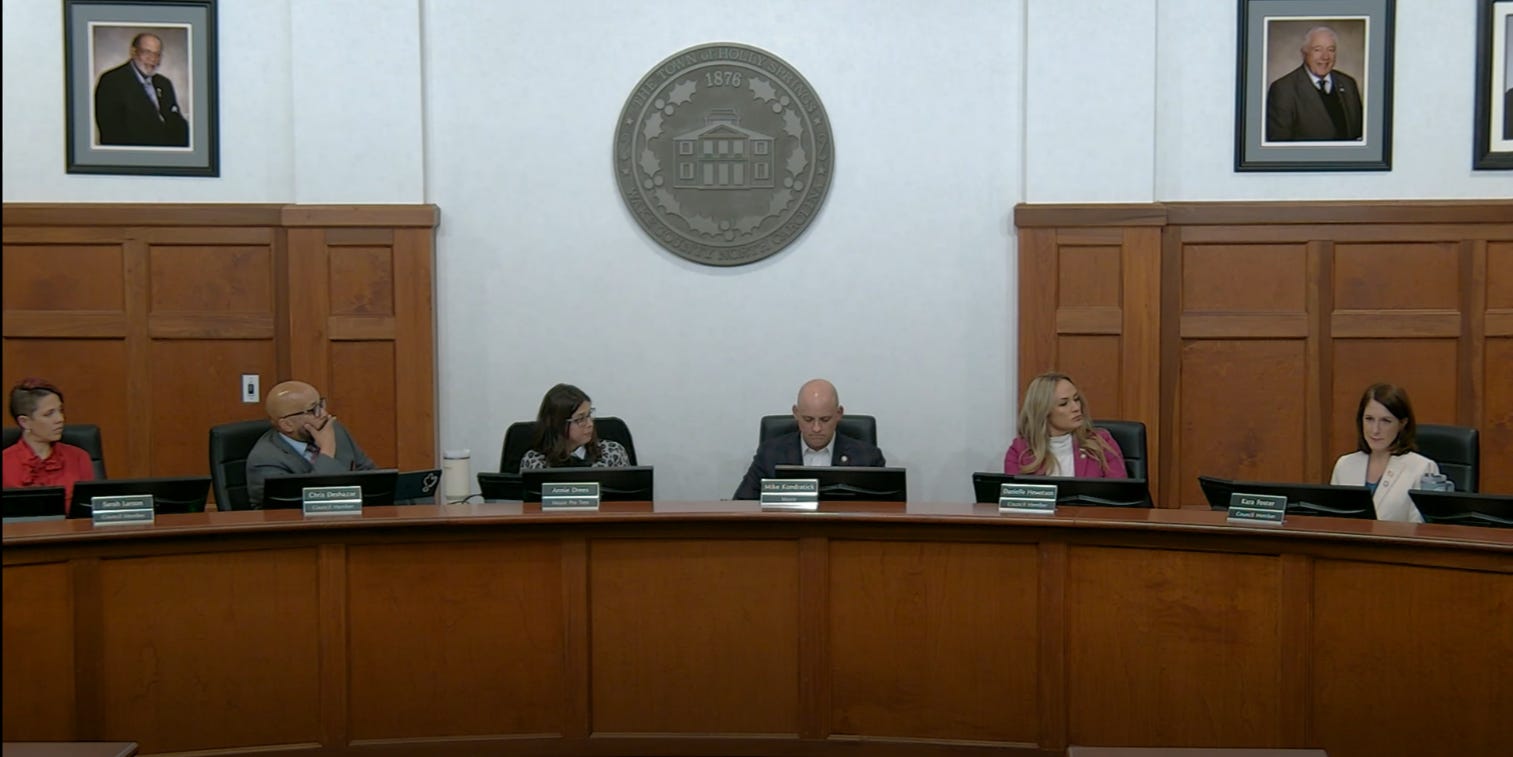
Holly Springs, NC, Feb. 18, 2026 — After several years of discussion and multiple public meetings, the Holly Springs Town Council voted last night to allow Wake County’s Non-Discrimination Ordinance (link) to apply within town limits and authorized an interlocal agreement allowing the county to enforce it locally.
The decision does not create a new Holly Springs ordinance. Instead, it formally adopts Wake County’s existing protections and places enforcement responsibility with county staff.
What the council approved
Town staff explained that county ordinances do not automatically apply inside municipal boundaries. Without council action, the county’s protections could not be enforced in Holly Springs even if an incident occurred within town limits.
By passing the resolution and authorizing the interlocal agreement, the council allowed Wake County’s rules covering discrimination in employment, contracting, and public accommodations to apply locally.
The move also ensures residents and businesses operate under the same framework used across much of Wake County, helping avoid confusion about enforcement and creating a consistent approach to protections countywide.
Enforcement remains county-run
Under the agreement, complaints originating in Holly Springs will be handled through Wake County’s existing process. County staff will receive reports of alleged discrimination and may refer parties to mediation through Campbell Law School, where disputes can be resolved voluntarily.
The ordinance also allows the county to seek court-ordered remedies if necessary, though the system is primarily designed to resolve disputes through conciliation rather than litigation.
The ordinance is civil rather than criminal in nature. It does not impose criminal penalties, relies primarily on mediation and equitable remedies, includes exemptions for religious organizations in certain contexts, and does not create a new private right to sue the county. Existing state and federal anti-discrimination laws remain the primary avenues for formal legal action.
Town leaders emphasized that centralizing enforcement at the county level avoids duplicating administrative systems while maintaining uniform protections for residents.
Council discussion reflected competing priorities
Several council members framed the vote as less about changing business practices and more about aligning local policy with existing norms.
One member, speaking as a small-business owner, said most employers already hire based on qualifications rather than discriminatory factors and argued that the ordinance largely reinforces what responsible businesses already do.
Others focused on community identity, saying formal adoption signals the kind of town Holly Springs aims to be as it continues to grow and attract new residents and employers.
At the same time, the debate also surfaced concerns about legal authority and precedent.
Town Attorney John Schifano noted that municipalities face limits under state law when directly regulating employment practices, but distinguished the current action from adopting a standalone local ordinance. Because the county would enforce its own law, the town’s exposure would likely be limited, though litigation risk can never be entirely ruled out.
Public comment revealed a clear divide
Resident comments reflected the same split that has surfaced in prior discussions.
Supporters described the ordinance as a statement of fairness and empathy, arguing that protecting vulnerable residents strengthens community cohesion and ensures all residents feel welcome.
Opponents questioned whether additional rules were necessary given existing federal and state protections. Some warned that new requirements could increase costs or compliance burdens for small businesses, particularly those without in-house legal support.
Others argued that the limited number of historical discrimination cases suggested no urgent local problem requiring a new policy.
Final vote formalized a long-running conversation
Following a lengthy discussion, council members approved the resolution extending the county ordinance into Holly Springs and then passed a second motion authorizing the interlocal agreement with Wake County.
What happens next
With the agreement in place, Wake County will manage complaint intake and mediation processes for incidents occurring in Holly Springs.
For residents, the change means the county’s protections now apply within town boundaries. For council members, the vote closes a multi-year policy discussion while leaving open the possibility of revisiting the issue if legal or practical challenges arise.
Mayor Mike Kondratick framed the decision as aligning the town’s laws with its character, saying adoption of the county ordinance ensures “the letter of our law matches the power of your example,” and affirming that Holly Springs “offers a home to everyone without question and without exception.”
Who and what is this ‘protecting’ exactly? Is this about Muslims? Is this how they flooded Texas and plan to overtake North Carolina? If so, this needs to be stopped. North Carolina is the quintessential American way of life. Assimilation of others should be the priority.