
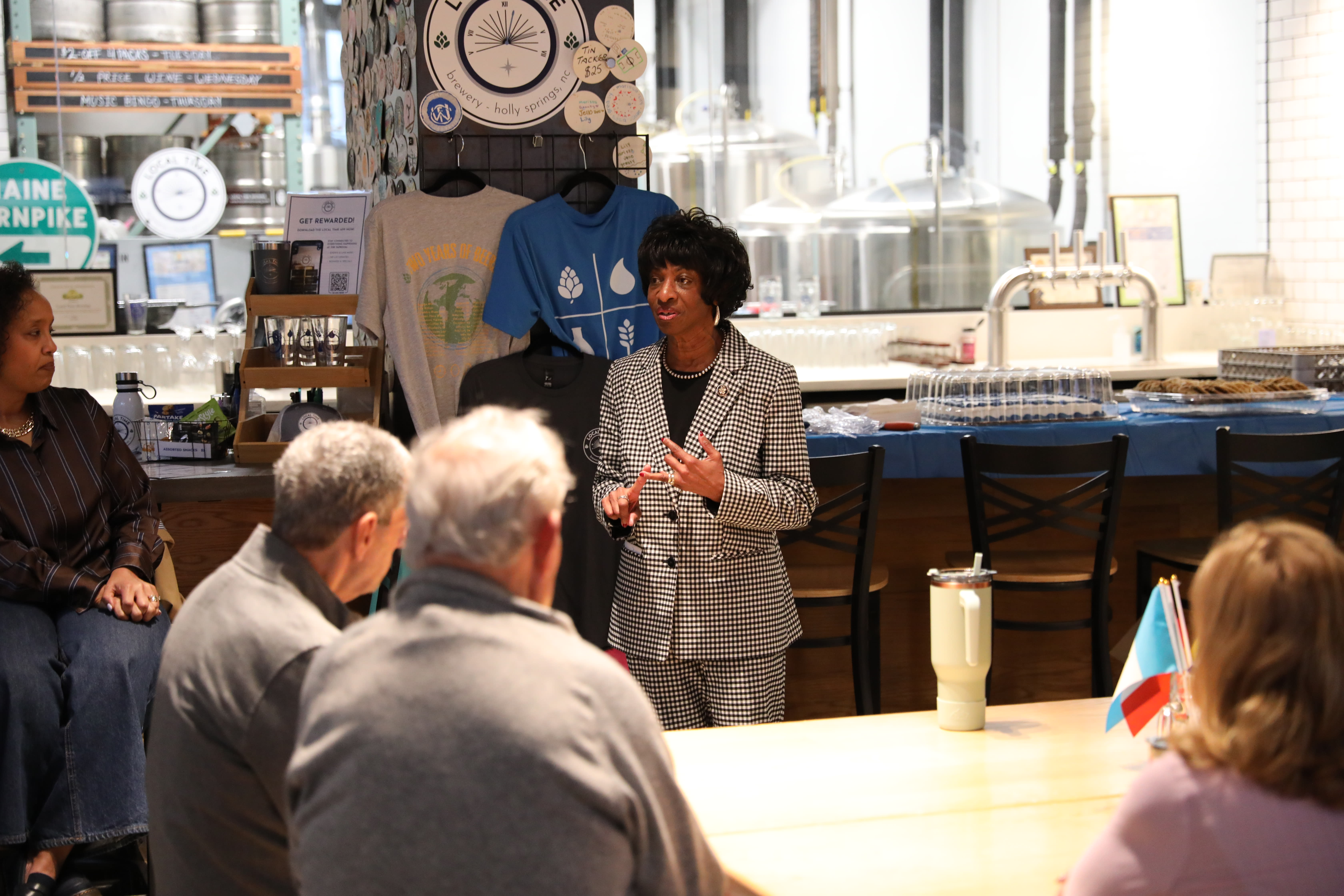
Holly Springs, NC, May 11, 2026 — An evening gathering tonight at Local Time Brewery in downtown Holly Springs featuring U.S. Rep. Valerie Foushee evolved into a broader discussion about affordability, political messaging, voter frustration, and whether public institutions are effectively addressing everyday concerns.
While the event included sharp criticism of national political leadership and partisan conflict, much of the nearly hour-long conversation centered on rising household costs, including housing, groceries, healthcare, insurance, utilities, and education expenses.
Foushee repeatedly argued that affordability concerns must remain central to political discussions heading into the 2026 election cycle, connecting many of those pressures to broader federal spending priorities and congressional decision-making.
Some of the evening’s most notable exchanges came when attendees questioned whether current political messaging is resonating with voters focused primarily on economic concerns.
Several participants argued that national political conversations have become overly centered on scandal, controversy, and partisan conflict, while many voters are more concerned about practical issues such as affordability and economic stability. One attendee said discussions surrounding investigations and political controversy are unlikely to persuade voters who are primarily worried about paying bills, affording groceries, and supporting their families.
Others pushed for clearer communication focused on lowering household costs, stabilizing healthcare costs, addressing housing affordability, and, more specifically, explaining how policies would improve daily life.
Foushee defended the broader focus on affordability and cost-of-living issues, pointing repeatedly to rising prices at grocery stores, gas pumps, and healthcare providers as evidence that economic concerns are already central to current political discussions. At the same time, she acknowledged the importance of coalition-building, grassroots organizing, voter outreach, and practical engagement with frustrated voters.
The discussion also reflected broader frustration with political institutions and modern public discourse.
Attendees raised concerns about declining trust in Congress, confusion surrounding voting laws, fragmented media environments, and whether government agencies are adequately staffed and funded to meet public needs. Several participants argued that political confusion and information silos are making civic participation more difficult and deepening public distrust.
Participants repeatedly emphasized voter turnout, post-primary unity, and sustained civic engagement as critical heading into the 2026 elections.
Though the gathering reflected strong political viewpoints, the most consistent theme of the evening was broader frustration over affordability, distrust in institutions, and whether political leaders are effectively addressing the pressures facing ordinary households ahead of the 2026 elections.